NNN Lease Assignment and Subletting Rights: What Every Landlord Needs to Know
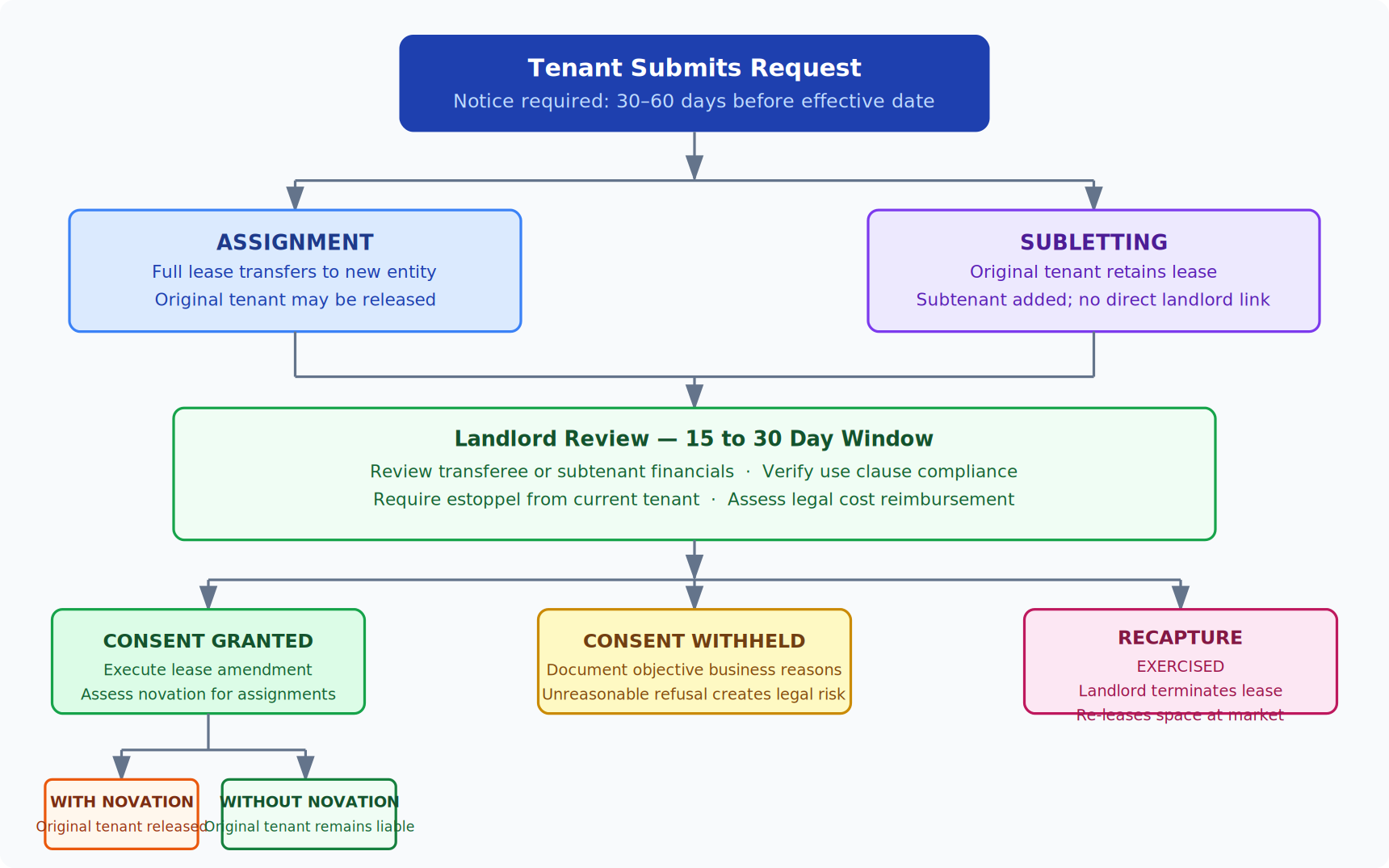

When a NNN tenant tells you they're selling their business — or wants to bring in another company to share the space — your response window is short and the stakes are high. Assignment and subletting are among the highest-friction situations in commercial lease management, and the outcome depends almost entirely on the consent language you negotiated when the lease was signed.
Here's what landlords need to understand before that call comes.
---
Assignment vs. Subletting: What's Actually Different
These two terms get used interchangeably, but they're legally distinct and carry different consequences.
In an assignment, the tenant transfers the entire lease to a new entity. They step out; the assignee steps in. From the assignment date forward, the new entity is responsible for rent, NNN expenses, and all lease obligations. The original tenant's role depends on whether you've agreed to a novation — more on that below.
In a subletting, the original tenant keeps the lease and brings in a subtenant for part or all of the space. Two relationships now exist: yours with the original tenant, and the original tenant's with their subtenant. You have no direct relationship with the subtenant unless your lease creates one. The original tenant remains fully liable to you regardless.
The practical difference: subletting keeps your creditworthy original tenant on the hook. Assignment does not — unless your consent is structured carefully.
---
Your Consent Rights and How to Structure Them
Most NNN leases require the tenant to obtain your consent before assigning or subletting. What they vary on is the standard that governs that consent.
Reasonable consent standard: The most common clause. You must not unreasonably withhold, condition, or delay consent. In practice, this means you can evaluate the transferee's financial strength and business compatibility, but you can't simply refuse because you'd prefer the original tenant to stay. Courts have found certain landlord objections unreasonable — be specific and document your reasoning.
Absolute consent: You retain full discretion. Less common in standard NNN leases, but sometimes negotiated. If your lease gives you absolute right to approve or deny, that's a meaningful position to hold.
Recapture right: A landlord-favorable provision. When the tenant requests consent to assign or sublet, you have the option to reclaim the space instead of consenting. The original lease terminates; you regain the space and can re-lease it at current market. This is most valuable when the assignment request reveals that market rent has climbed above what the tenant is paying — the tenant is essentially trying to monetize a lease spread by assigning.
Profit participation: If the tenant assigns or sublets for rent above the base rent in their lease, many leases require a share of that excess to go to the landlord. If your tenant is paying $25/sf and subletting to someone at $32/sf, you may be entitled to 50% of the $7 spread. This clause is easy to overlook and rarely tracked systematically.
---
What You Should Require Before Consenting
Consenting to an assignment or subletting is a business decision, not a formality. Before you agree:
Transferee financials. Request two to three years of financial statements or tax returns from the proposed assignee or subtenant. For assignment, you're evaluating whether the incoming entity can carry NNN obligations through the lease term. For subletting, you're evaluating the financial strength of the entity that will actually occupy your property.
Business information. Is the proposed use consistent with your use clause and your center's tenant mix? Does the subtenant or assignee conflict with exclusivity provisions you've granted to other tenants?
Estoppel certificate from the current tenant. Before consenting to an assignment, require the current tenant to execute an estoppel confirming lease status — current rent, no landlord defaults alleged, no side agreements in place. This closes off future claims that you consented knowing the lease was in dispute. For more on how estoppels work in transaction contexts, see NNN Tenant Estoppel Certificates: The Landlord's Guide to Getting Them Right.
Reimbursement of legal and review costs. Consent review takes attorney time. Most leases allow you to charge reasonable review costs as a condition of consent.
---
The Liability Trap: Who Stays on the Hook After Assignment
This is where landlords get hurt.
When a tenant assigns a lease, the default outcome under most NNN leases is that the original tenant remains liable as a co-obligor. The assignee is now the primary party — they pay rent, handle NNN expenses, maintain the space. But if they default, you can pursue the original tenant for the shortfall. The original lease guarantee typically survives assignment unless you've explicitly released it.
A novation changes this. In a novation, the original tenant is fully released from all future obligations. The assignee takes on sole liability. Landlords sometimes agree to novations when the assignee is financially stronger than the original tenant — but agreeing without comparison is a mistake. If the original tenant is a franchisee backed by a credit parent company and the assignee is a startup, you've just traded a creditworthy guarantor for an unknown risk.
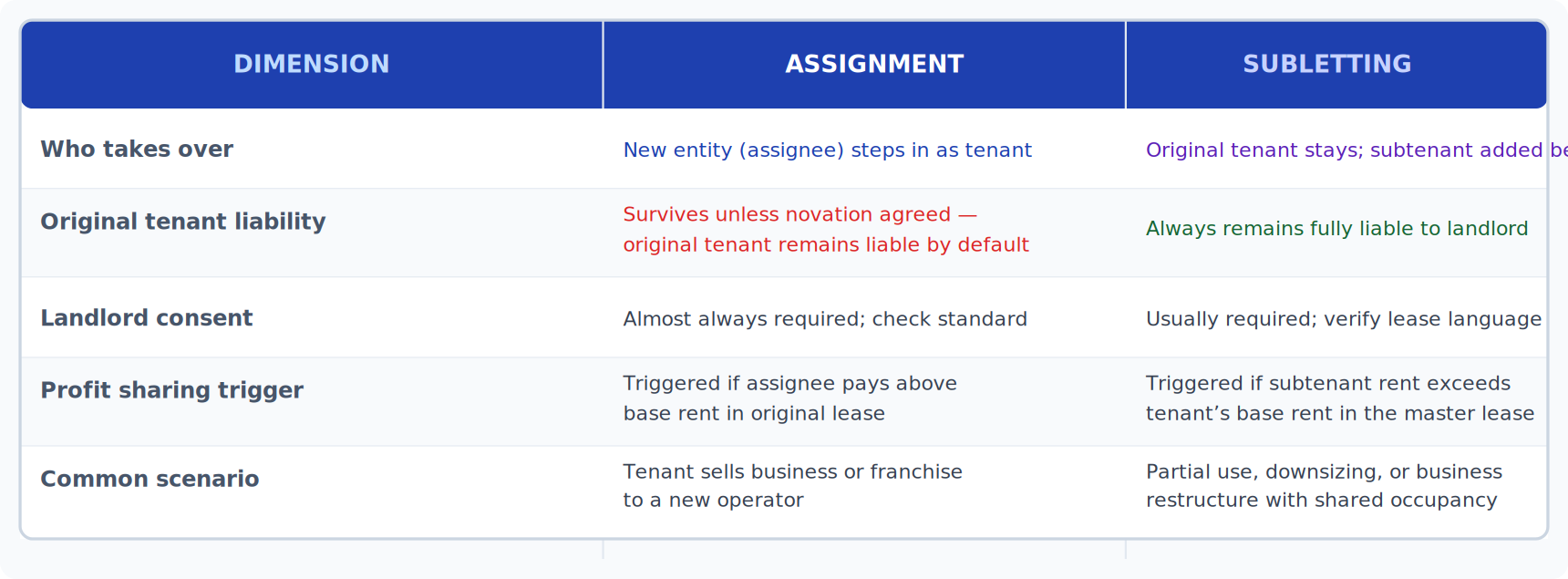
Never consent to a novation without understanding who you're releasing and whether the incoming entity's financial profile justifies it.
---
Deadlines You Can't Miss
Assignment and subletting provisions are deadline-driven on both sides.
Tenants typically must provide notice 30 to 60 days before the proposed assignment date. Your consent window — the period in which you must respond before consent is deemed given or the tenant can proceed — is usually 15 to 30 days from when you receive a complete request package.
The recapture right, if your lease includes one, has its own window: often 30 days from the date of the tenant's notice. Miss that window and you've lost the right to reclaim the space for this transaction.
Profit participation clauses trigger on the effective date of the sublease or assignment and may require you to request financial documentation within a set period to enforce your share.
None of these deadlines are intuitive. They don't follow a calendar — they run from specific events. Tracking them manually across a multi-tenant portfolio means one missed window can cost you leverage you can't recover.
---
How PigJet Tracks Assignment and Consent Deadlines
Assignment and subletting triggers are exactly the kind of lease events that fall through the cracks without a system built around them.
PigJet tracks assignment notice dates and consent windows per lease, surfacing them before deadlines expire. Recapture rights are flagged when a request comes in — you see the window, the deadline, and what the lease requires before you respond. Profit participation clauses are modeled at the lease level so you're not rediscovering them mid-transaction.
When an assignment closes, PigJet records whether a novation was executed and tags original tenant liability status accordingly. That information surfaces at renewal, when you're re-evaluating exposure, and any time you need to understand who's actually on the hook for the rent.
Visit pigjet.com to see how PigJet handles lease event tracking, consent deadline management, and assignment history across your portfolio.