NNN Tenant Estoppel Certificates: The Landlord's Guide to Getting Them Right
What Is an Estoppel Certificate and Why Do NNN Landlords Need One
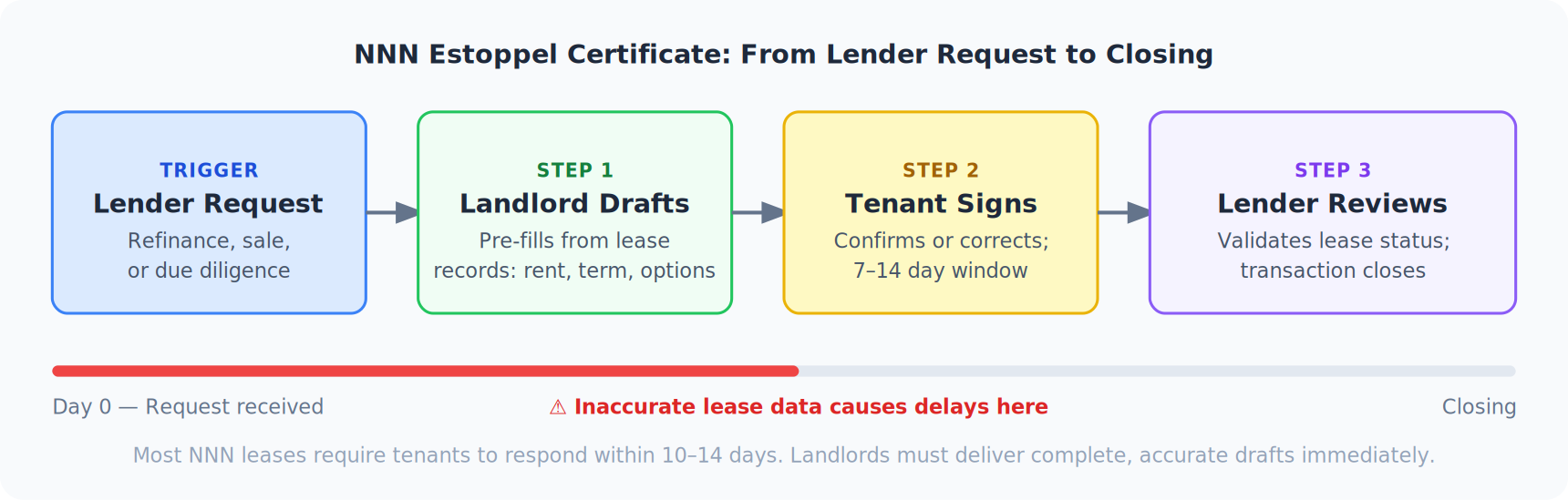
A tenant estoppel certificate is a signed document in which your tenant confirms the current status of their lease — the rent they pay, the term remaining, any amendments in effect, and whether there are any landlord defaults they're alleging. It is not a legal filing. It is not part of the lease itself. It is a snapshot of the lease relationship, certified by the tenant, handed to a third party.
That third party is almost always a lender or a buyer.
When you refinance an NNN property, the incoming lender will underwrite your tenancy. They want to know that the lease terms you've represented are accurate, that the tenant isn't in default, and that there are no side agreements or amendments that could affect the income stream. An estoppel certificate is how they verify all of this directly with the tenant rather than relying solely on your representations.
The same logic applies to a sale. A buyer's lender — or a sophisticated buyer without a loan — will require estoppels before closing. They need to hear from the tenant directly that the lease is as described.
This is not optional. Most NNN leases include a clause requiring tenants to provide an estoppel certificate within a fixed window — typically 10 to 14 days — whenever the landlord requests one. Failure to respond within that window is often treated as a deemed certification that the landlord's draft is accurate.
---
When NNN Landlords Need Estoppel Certificates
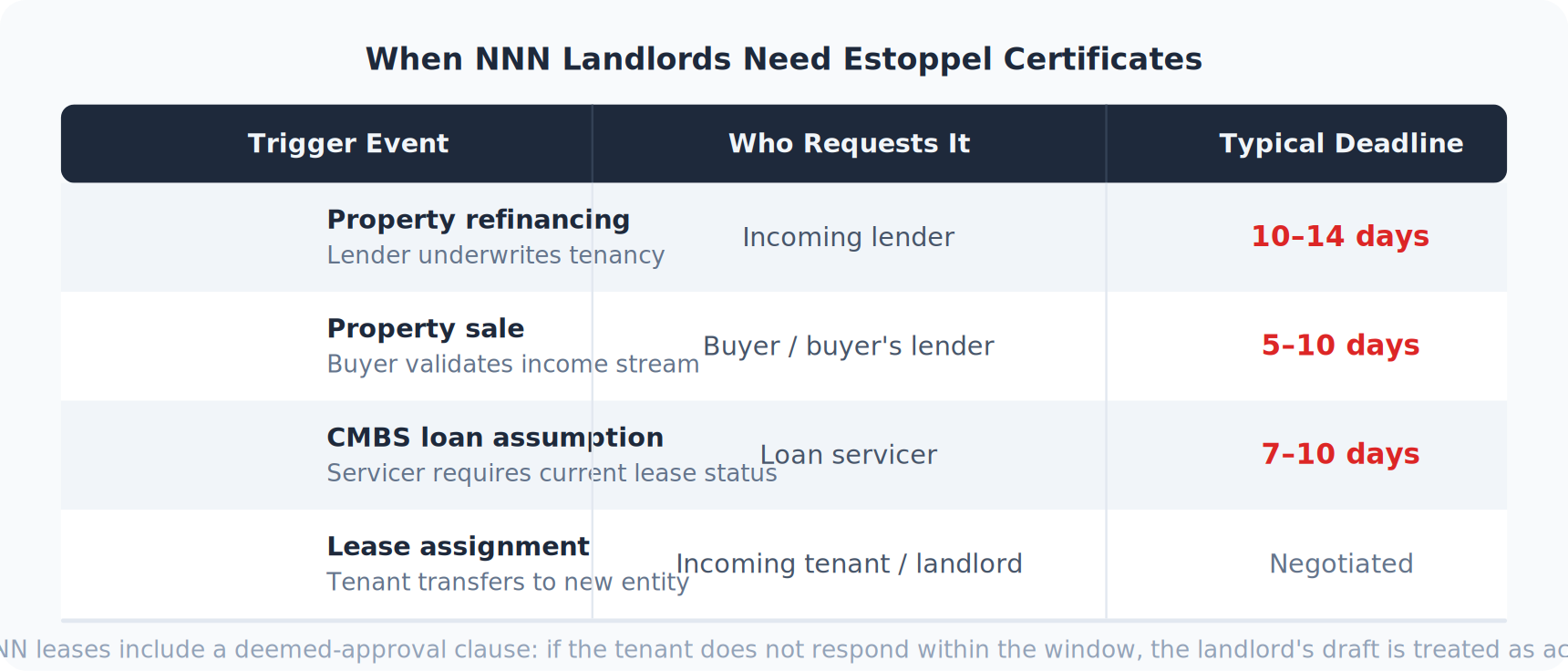
The four situations where you'll need them:
Property refinancing. The incoming lender is underwriting your property based partly on the quality of your tenancy. They want to verify lease terms, rent amounts, remaining term, and any pending disputes — directly from the tenant, not from you. This is the most common trigger for estoppel requests at small NNN portfolios.
Property sale. Buyers need to validate that the income stream they're paying for matches what was disclosed. A signed estoppel from each tenant is often a closing condition. If a tenant raises a dispute or discloses an unresolved issue in the estoppel, that can affect the purchase price or delay closing.
CMBS loan assumption. When an NNN property changes hands and the buyer assumes an existing CMBS loan, the servicer typically requires fresh estoppels. CMBS servicing is procedural — they follow the pooling and servicing agreement, and tenant certifications are usually a required closing item.
Lease assignment. When a tenant assigns their lease to a new entity — a common occurrence when franchise tenants sell their operations — the landlord or the incoming entity may require an estoppel to document the lease status at the time of assignment.
In all four cases, you'll typically have 10 to 14 days from the request to deliver signed estoppels from all tenants. For a single-tenant property, that's straightforward. For a multi-tenant retail strip with five or eight tenants, the timing requires active coordination.
---
What an Estoppel Certificate Contains
The exact form varies — lenders often provide their own template, and sophisticated buyers sometimes do too. But the core content is consistent across virtually every estoppel form:
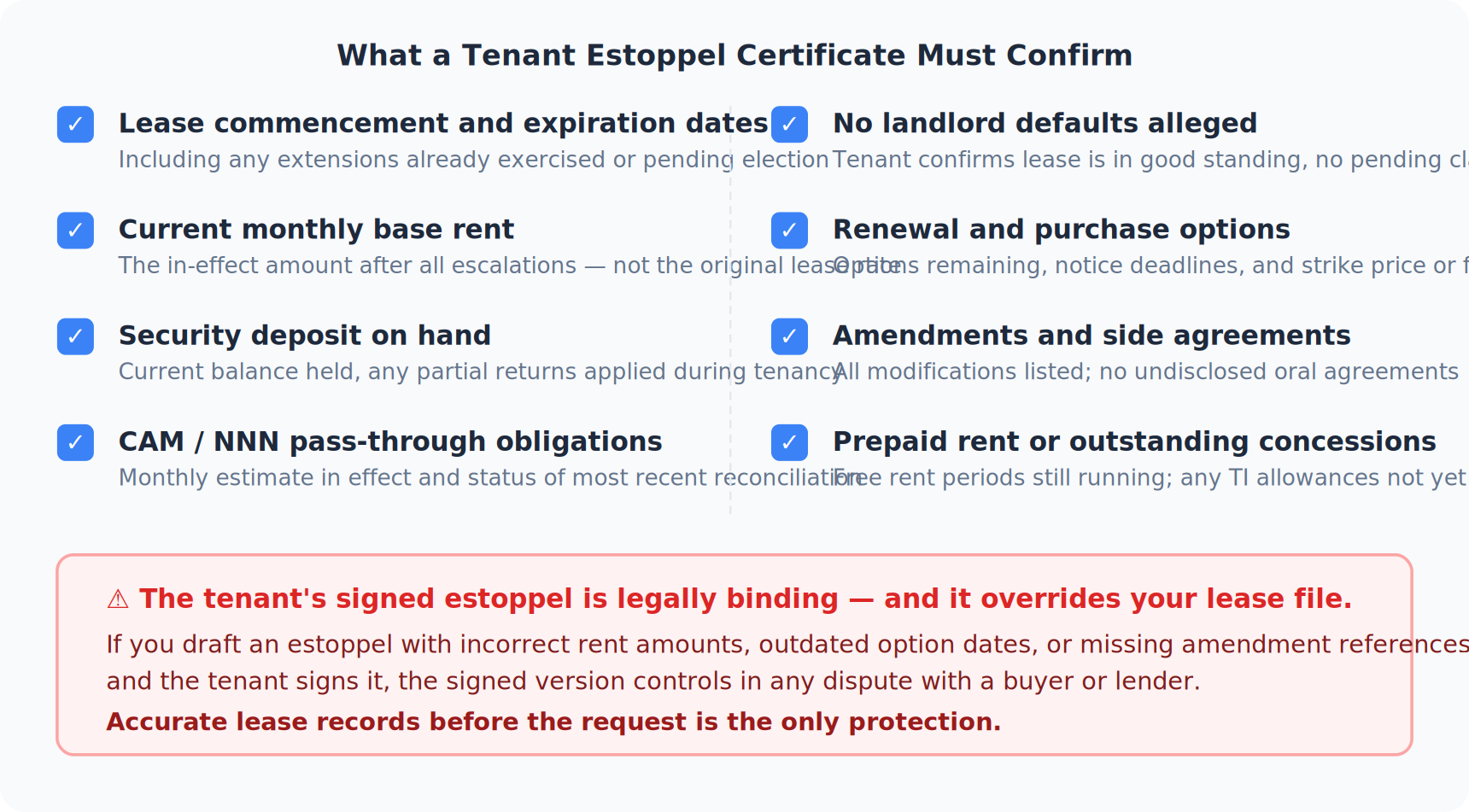
Lease commencement and expiration dates. Including the current expiration if any options have been exercised. This is where outdated records create problems: if your system shows the original expiration but the tenant exercised a five-year renewal three years ago, the dates won't match.
Current monthly base rent. Not the original lease rate — the current rate after any escalations. If the lease has fixed bumps and your records haven't been updated to reflect the current period, the estoppel will surface the discrepancy.
Security deposit on hand. The amount currently held, including any partial returns. If you've returned a portion of the deposit over the tenancy and your records don't reflect it, this is where it comes out.
CAM and NNN obligations. The current monthly estimate and the status of the most recent reconciliation. If last year's reconciliation is outstanding and you haven't resolved it, the tenant may note it here.
No landlord defaults. The tenant certifies they have no pending claims or allegations of default against the landlord. This is the field that can hold up a closing. If a tenant has been pressing you on a maintenance issue, a disputed CAM charge, or an unresolved repair obligation, it may appear here.
Renewal and purchase options. Any remaining options, their notice deadlines, and if applicable, the option price or calculation method. Options that have already expired or been waived should be noted as such.
Amendments and side agreements. The tenant certifies that the lease documents listed are the complete agreement — no verbal side deals, no side letters, no unexecuted amendments with disputed status. If amendments exist that aren't in your records, the tenant's estoppel will surface them.
Prepaid rent or concessions. Any free rent periods still running, landlord improvement allowances not yet applied, or tenant credits outstanding.
---
Why Landlords Struggle With Estoppels
The typical small NNN portfolio operates with lease files in various states of completeness. Original leases are usually organized. Amendments get filed less reliably. Rent escalation schedules may exist as attachments to the original lease but not in any running ledger. Option deadlines may be tracked in a spreadsheet that was last updated two years ago.
When an estoppel request arrives with a 10-day deadline, the landlord has to:
1. Pull the complete lease file, including all amendments, for each tenant. 2. Identify the current rent amount based on whatever escalation schedule is in effect. 3. Calculate remaining term including any exercised options. 4. Determine whether any reconciliations are outstanding. 5. Confirm what options remain unexercised and their deadlines. 6. Draft the estoppel form — or complete the lender's template — for each tenant. 7. Send it to each tenant, coordinate execution, and return it within the window.
Step 1 through 6 should take a few hours if your records are current. In practice, they frequently take several days — because the lease file is incomplete, because the current rent requires back-calculating several years of CPI adjustments, or because the last amendment lives in an email thread and not in the lease folder.
> The tenant's estoppel signature creates a binding record. If your draft is wrong and the tenant signs it, the signed version controls — not your lease file, not your original understanding.
This is why estoppel quality depends entirely on the accuracy of your lease records going in. A landlord who knows exactly what every lease says, what the current rent is after all escalations, and what options remain unexercised can draft an estoppel in 30 minutes. A landlord reconstructing that information from incomplete files under a closing deadline is a different situation entirely.
---
How to Get Estoppels Done Without a Transaction Panic
Keep your lease abstractions current. A lease abstraction is a structured summary of the key economic and operational terms of each lease — rent schedule, term, options, CAM provisions, key dates. If you maintain accurate abstractions, drafting an estoppel is largely a matter of transferring that information onto a form.
Track amendments as they happen. Every amendment should be added to the lease record immediately. Not filed separately, not tracked in a sidebar note — linked to the primary lease record so that when you pull the lease for any purpose, the full picture is there.
Resolve outstanding reconciliations before you need an estoppel. Tenants who have an unresolved CAM dispute or a pending landlord obligation will note it in the estoppel. Resolving these before a transaction is both cleaner and faster.
Pre-draft your estoppel template. Have a landlord-friendly estoppel template ready before you need one. Many lenders will provide their own form, but if you have a clean template in advance, you can sometimes negotiate to use yours — which gives you more control over the framing.
Contact tenants early. The moment you know a transaction is coming, reach out to tenants directly before the formal estoppel package arrives. A 30-second call heads off the "what is this document" delay that eats three days of a 10-day window.
---
How PigJet Helps With Estoppel Prep
PigJet's lease management workflow captures the fields that go into an estoppel at the time of lease abstraction — rent schedules, key dates, options, amendment history, CAM provisions. When a lender request arrives, that data is already structured and current, not scattered across file folders and email threads.
Because PigJet tracks rent escalations in line with your lease terms — fixed bumps, CPI adjustments, step schedules — the current rent figure is accurate without requiring you to reconstruct it from a schedule attachment. Option deadlines surface in the property timeline before they become urgent, so you know what's exercised and what remains before someone asks.
The QuickBooks integration also helps here: PigJet can cross-reference your payment records against the lease terms, so you know whether CAM estimates are current and whether any reconciliation amounts remain unresolved before a transaction surfaces them in an estoppel response.
> An estoppel certificate is a test of your lease records. If your records are accurate and current, it's a form you fill out. If they're not, it's a problem you discover at the worst possible time.
For NNN landlords managing multiple tenants across multiple properties, the value of clean, abstracted lease data isn't abstract. It shows up directly when a lender sends an estoppel request on a Friday with a two-week deadline and you need to respond for eight tenants by the end of the following Friday.
---
The workflow isn't complicated. But it requires that your lease records — rent amounts, options, amendments, CAM status — are accurate before someone else needs them to be. For landlords already using PigJet, that data is maintained in the course of normal lease administration. For landlords starting from file folders and spreadsheets, the first estoppel request under deadline pressure is often the moment they decide to change the system.