CAM Reconciliation Calendar for NNN Landlords
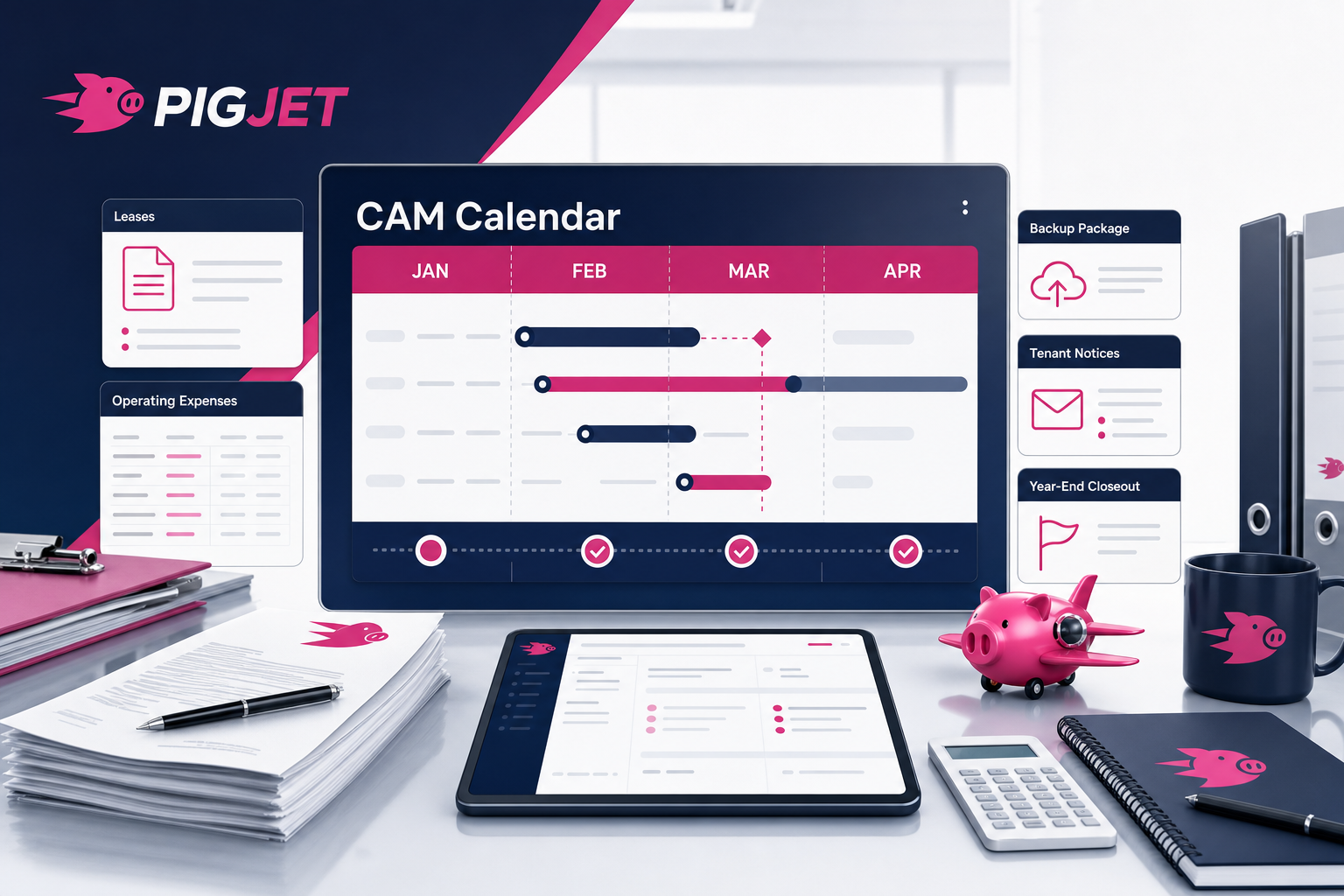
CAM Reconciliation Is an Annual Event, But the Work Is Monthly
Most NNN landlords feel CAM reconciliation pressure in the first quarter. That is when tenants expect year-end statements, accountants ask for backup, and every odd expense from the prior year suddenly needs a lease answer.
The mistake is treating reconciliation as one project. It is really a calendar. If you keep lease terms, invoices, estimates, and tenant notices current throughout the year, the final statement becomes a controlled closeout instead of a scramble.
This calendar is built for small and mid-size NNN landlords managing retail, office, medical, or mixed commercial properties. Use it alongside your lease files, accounting records, and CAM reconciliation checklist.
> The goal is not to make CAM reconciliation complicated. The goal is to make each month boring enough that year-end is defensible.
January: Lock the Prior Year and Open the New One
January has two jobs: close the year that just ended and set the assumptions for the year ahead.
For the prior year, pull the full operating expense ledger by property. Separate CAM, taxes, insurance, utilities, management fees, repairs, and any tenant-specific charges. Do not wait until March to discover that landscaping invoices were posted to the wrong property or that a roof repair needs a capital expense review.
For the new year, confirm each tenant's estimated CAM billing amount. If your lease allows annual estimate adjustments, January is the month to compare last year's actual costs against this year's budget. Large jumps should be documented before tenants see them on invoices.
January tasks:
- Export prior-year actual expenses by property and category
- Confirm all December invoices are posted or accrued
- Review each tenant's CAM estimate for the new year
- Flag any expense category that materially increased from the prior year
- Confirm the reconciliation deadline in each lease
If your lease requires delivery within 90 days of year-end, January is not early. It is the first third of the deadline.
February: Review Lease Terms Before You Run the Math
February should be lease review month. A clean ledger is not enough if the calculation applies the wrong lease rule.
Pull the current executed lease, amendments, extensions, side letters, and any prior reconciliation notes for every tenant. Confirm pro-rata share, rentable square footage, cost pools, CAM exclusions, caps, gross-up provisions, audit rights, and statement delivery rules.
This is where many landlord mistakes start. One tenant may have a 5% cap on controllable expenses. Another may exclude management fees. A third may be in a separate cost pool because it has direct utility metering or a different parking allocation.
February tasks:
- Confirm current lease documents and amendments are in one place
- Recheck each tenant's pro-rata share source
- Identify CAM caps and whether they apply to all expenses or only controllable expenses
- List excluded expenses by tenant
- Note audit-right windows and required backup language
For a deeper lease workflow, use the NNN lease administration checklist as the companion to this calendar.
March: Draft the Reconciliation Statement and Backup Package
March is when the reconciliation should move from raw data to tenant-ready statement.
Start by reconciling total actual expenses to the accounting system. Then remove excluded items, apply cost pools, calculate each tenant's pro-rata share, test caps, subtract estimated payments already collected, and document the balance due or credit.
Do not make the backup package an afterthought. Tenants are less likely to object when they can see how the numbers were built. A good package includes the expense summary by category, pro-rata share calculation, cap calculation if applicable, prior-year comparison, and a short explanation of unusual increases.
March tasks:
- Complete the final expense rollup by property
- Remove excluded or tenant-specific expenses
- Apply gross-up provisions where the lease requires them
- Calculate tenant shares, caps, credits, and balances due
- Prepare backup that matches the statement line by line
- Send internal review copies before tenant delivery
If your lease deadline is March 31, build in review time. A statement sent on time with weak math can still create a dispute.
April: Deliver Statements and Track Tenant Responses
For many calendar-year leases, April is the final delivery window. Some leases use 90 days. Others use 120 days. A few use a different fiscal year. The lease controls.
Send the reconciliation exactly as the notice provision requires. If the lease says certified mail, do not rely only on email. If email is permitted, keep the delivery receipt and preserve the sent message with attachments.
Once statements go out, track every tenant response. Even a casual "can you send backup?" should be treated as part of the reconciliation file. If a tenant objects, answer in writing and tie your response back to the lease language and source documents.
April tasks:
- Deliver statements by each lease deadline
- Save proof of delivery
- Log balances due, credits, and payment due dates
- Respond to backup requests in writing
- Track objections and resolution status
For deadline risk, read CAM reconciliation deadlines and late penalties. Missing a deadline can limit collection rights in some leases.
May and June: Resolve Disputes and Clean the File
By May, the initial tenant questions should be visible. This is the time to close them, not let them drift into the next cycle.
Separate normal clarification requests from real objections. A tenant asking for invoices is different from a tenant claiming a charge is excluded. For objections, identify the disputed category, the tenant's lease position, your response, and whether a credit or correction is required.
Do not treat small corrections as failure. If an expense was miscoded, fix it, send the revised statement, and preserve the explanation. A clean correction process is better than defending a bad number.
May and June tasks:
- Confirm receipt of balances due
- Apply credits according to lease terms
- Resolve open backup requests
- Document tenant objections and outcomes
- Update your reconciliation template with lessons learned
This is also a good time to review whether your estimates were too low. If tenants owed large true-up balances, consider whether the current year's estimates should be adjusted.
July: Run a Mid-Year CAM Variance Review
July is the most useful month most landlords skip.
Pull year-to-date CAM expenses and compare them to the annual budget. Look for categories that are already running hot: snow removal, utilities, insurance, parking lot repairs, security, landscaping, janitorial, or management fees.
The purpose is not only budgeting. It is tenant communication. If insurance is up 22% or a common-area repair program is going to hit CAM, tenants should not learn about it for the first time in next year's reconciliation packet.
July tasks:
- Compare year-to-date actuals against annual estimates
- Flag categories likely to exceed budget
- Confirm whether high-variance expenses are recoverable under each lease
- Decide whether estimate adjustments are allowed or useful
- Document the business reason for unusual expenses
The mid-year CAM variance tracking guide walks through this review in more detail.
August and September: Audit Expense Coding and Vendor Backup
Late summer is a good time to clean accounting before the fourth-quarter rush.
Review vendor bills for coding errors. Confirm property allocations. Make sure tenant-specific work is not sitting in common CAM. Check whether any capital project was posted to repairs. If a lease allows amortized capital improvements, document the lease basis and amortization method before year-end.
This is also the time to chase missing invoices. Waiting until reconciliation season to ask a vendor for last August's backup is a predictable way to slow down the close.
August and September tasks:
- Review general ledger coding for CAM categories
- Remove direct tenant charges from common expense pools
- Identify capital expenses and lease treatment
- Collect missing invoices, contracts, and service notes
- Confirm insurance and tax bills are attached to the right property
Clean coding is one of the simplest ways to prevent tenant audit issues.
October: Prepare the Next Year's CAM Budget
October is budget month. Use current-year actuals, known contract increases, insurance renewals, tax expectations, and planned maintenance to draft next year's CAM estimate.
Do not copy last year's budget unless the property was truly stable. NNN tenants expect pass-throughs, but they also expect reasonable estimates. Underbilling all year and sending a painful true-up later creates more tenant friction than a well-explained estimate increase.
October tasks:
- Draft next year's CAM budget by property and category
- Update vendor contract assumptions
- Confirm known tax and insurance changes
- Compare estimate increases to lease caps, if relevant
- Prepare tenant-facing explanations for major budget changes
For a fuller budgeting workflow, use the annual CAM estimate budgeting guide.
November: Confirm Lease Changes and Tenant Roster Changes
November is the month to catch changes that affect the allocation math.
Review new leases, expansions, contractions, renewals, terminations, assignments, and amendments. Confirm whether any tenant's square footage changed. If a tenant moved in mid-year, moved out, or had a rent commencement delay, document how CAM is prorated.
This is especially important for multi-tenant retail centers. A small change in rentable square footage or occupancy assumptions can affect pro-rata shares, gross-up provisions, and year-end statements.
November tasks:
- Update the tenant roster by property
- Confirm move-in, move-out, and rent commencement dates
- Check square footage changes from amendments or expansions
- Confirm assignment or sublease obligations
- Review gross-up triggers for vacancy or partial occupancy
Lease changes should be documented before you start final reconciliation math.
December: Freeze the Checklist Before Year-End
December is not the time to solve every issue, but it is the time to know what is missing.
Create a year-end reconciliation checklist for each property. Identify open invoices, unposted expenses, missing tax bills, pending insurance charges, unresolved tenant questions, and lease terms that need review. Set owner names and dates for each item.
December tasks:
- Build a property-by-property close checklist
- Confirm all recurring vendor invoices are received
- Identify accruals needed for late bills
- Review tenant estimate payment history
- Schedule January reconciliation work
If you manage multiple properties, December planning is what keeps the first quarter from becoming one long emergency.
A Simple Quarterly Rhythm
If a monthly calendar feels too detailed, use this quarterly version:
- Q1: Close prior year, run reconciliation, deliver statements, track responses
- Q2: Resolve tenant questions, apply credits, update templates
- Q3: Review mid-year variance, clean expense coding, collect backup
- Q4: Build next year's budget, confirm lease changes, prepare close checklist
That rhythm works because it matches the actual risk pattern. Reconciliation disputes usually come from old mistakes: weak expense coding, stale lease terms, missing backup, poor estimate management, or late delivery.
Where Software Helps
This calendar can be managed manually. Many landlords do it with QuickBooks, folders, and spreadsheets. The issue is that every manual handoff creates a place for the reconciliation file to drift from the lease.
Good NNN property management software should help you:
- Keep lease rules tied to each tenant's CAM calculation
- Track estimate payments against actual expenses
- Separate recoverable, excluded, capital, and tenant-specific expenses
- Preserve backup by property, category, and statement line
- Spot variance before the year-end statement
- Produce a reconciliation package tenants can audit without guessing
PigJet's CAM reconciliation workflow is built around those operating steps: lease terms, pro-rata shares, caps, exclusions, estimates, and backup in one place. You can also use the free CAM calculator to test the math before you send statements.
Final Takeaway
CAM reconciliation is easier when landlords stop treating it as a single annual deadline. The defensible process is a calendar: close the books, check the leases, package the backup, communicate early, review variance, clean coding, and budget before the next year starts.
The landlords who have the fewest tenant disputes are usually not doing magic in March. They are keeping the file clean all year.
Related: Annual CAM Reconciliation Process | CAM Reconciliation Checklist | CAM Reconciliation Deadlines