How NNN Landlords Should Set Annual CAM Estimates Before the Year Starts
CAM Estimates Are Not Just a Billing Setup Task
For many NNN landlords, annual CAM estimates get treated like a quick accounting exercise. Last year's recoverable expenses are copied forward, a percentage increase is added, tenant shares are updated if someone remembers, and the new monthly charges are entered into the billing system.
That works until the true-up starts.
If the estimate was built from stale square footage, the wrong lease cap, a missing tax increase, or a budget category that the lease does not allow, the landlord does not just have a math problem. They have a tenant communication problem. The tenant sees a large year-end balance and asks why the monthly estimate was so far off.
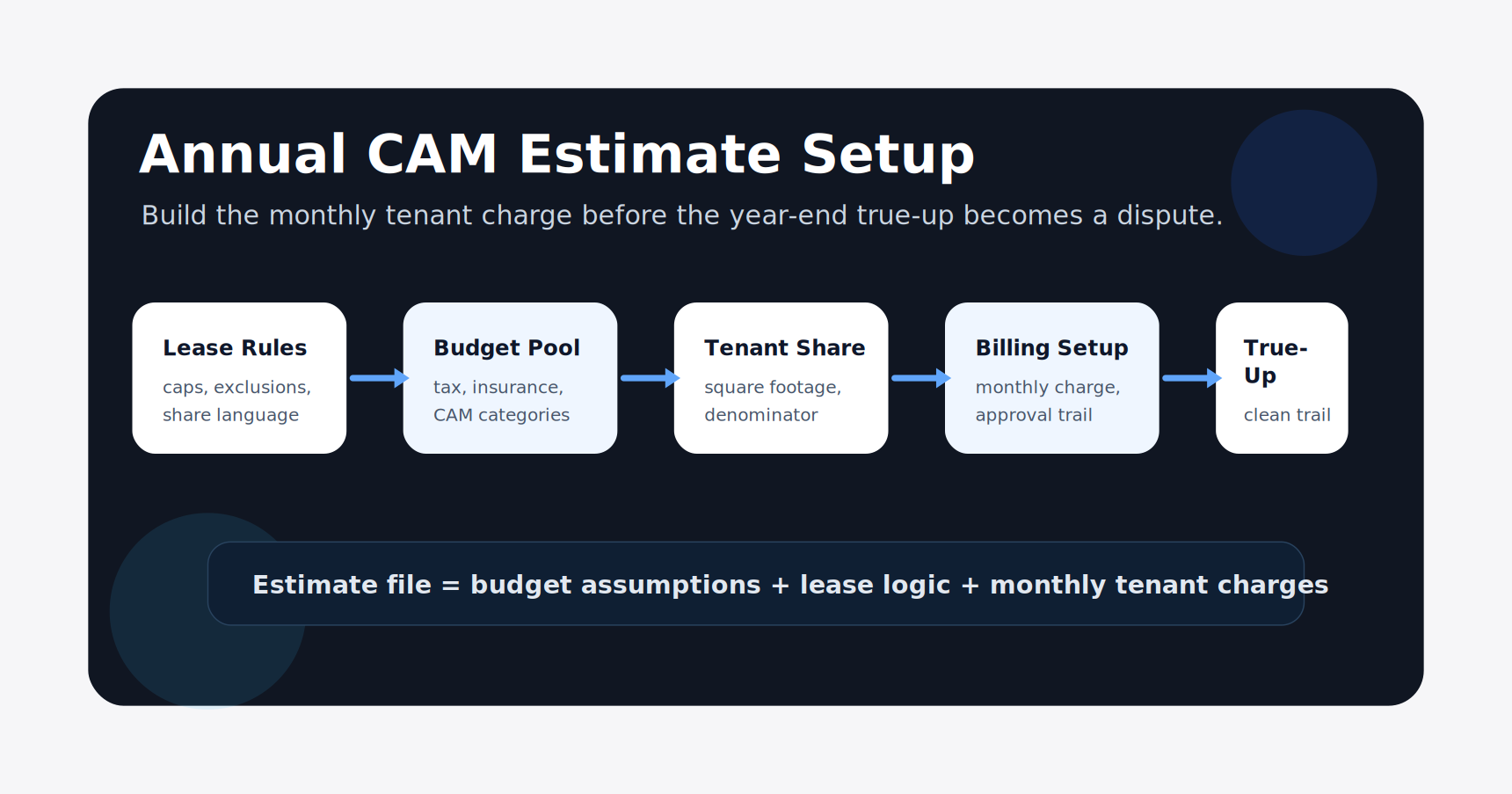
Annual CAM estimates should be built like the first step of the reconciliation package. The estimate should be lease-aware, tied to a real budget, and documented well enough that the year-end true-up is not a surprise.
Start With the Lease, Not the Prior-Year Spreadsheet
The first question is not "what did we bill last year?" It is "what does this tenant's lease allow us to estimate and recover?"
Before setting the estimate, confirm the tenant's CAM language:
- reimbursable categories
- exclusions and carveouts
- controllable expense caps
- management fee rules
- tax and insurance treatment
- gross-up rules for vacancies
- audit or notice timing
- base year or expense stop language, if any
- pro-rata share definition
- amendments that changed square footage or charges
This review matters because tenants in the same center may not have identical recovery terms. One tenant may reimburse management fees. Another may exclude them. One tenant may have a cap on controllable expenses. Another may not. One tenant's denominator may be the building, while another uses the shopping center or a defined common area pool.
If the estimate process starts from last year's billing schedule, those differences are easy to miss.
Build the Budget Before Allocating It
The CAM estimate should be based on a recoverable operating budget, not a raw accounting export.
Start with the property budget and separate expenses into categories that can be estimated and billed. For most small commercial landlords, the major buckets are familiar:
- common area maintenance
- landscaping
- snow removal
- parking lot repairs
- utilities for common areas or vacant suites
- property taxes
- insurance
- security
- property management fees
- repairs and maintenance
- janitorial or trash service
Then remove items that should not be in the recoverable pool for the tenant or property. Examples include owner legal fees, leasing commissions, capital work that is not recoverable under the lease, tenant-specific repairs, financing costs, penalties, and non-cash accounting entries.
This is where QuickBooks alone usually falls short. QuickBooks may be the accounting record, but it does not know which lease allows which category, which tenant has a cap, or which expense should be excluded from one tenant's recovery pool.
Separate Predictable Costs From Volatile Costs
Not all estimate inputs deserve the same treatment.
Some costs are fairly predictable. Contracted landscaping, trash service, routine janitorial work, and management fees may be known before the year begins. Other costs can swing: insurance renewals, property taxes, snow removal, utilities, casualty repairs, and vacancy-related expenses.
Treat those groups differently. For predictable categories, use actual contract amounts where possible. For volatile categories, use the best available evidence:
- tax assessment notices
- insurance renewal indications
- vendor proposals
- prior-year actuals adjusted for known changes
- vacancy assumptions
- planned maintenance schedules
- utility rate changes
The goal is not to guess perfectly. The goal is to make the estimate reasonable and explainable.
If the property had a one-time parking lot repair last year, do not blindly carry it forward. If insurance is renewing at a materially higher rate, do not ignore it just because last year's actuals were lower. If a suite will be vacant for six months and the landlord will carry utilities, document the assumption.
Apply Tenant Shares After the Pool Is Clean
Once the budget is clean, calculate tenant shares.
For a standard NNN lease, that usually means multiplying the recoverable pool by the tenant's pro-rata share. But the phrase "pro-rata share" hides details that matter:
- Is the numerator the tenant's leased square footage or occupied square footage?
- Is the denominator the building, the center, or a specific cost pool?
- Did a suite expansion or contraction change the share?
- Are vacant suites included in the denominator?
- Are anchor tenants excluded from certain categories?
- Are taxes and insurance allocated differently than CAM?
Small errors here compound all year. If a tenant is billed a monthly estimate based on the wrong share, the year-end true-up may look like a sudden charge even though the underlying expenses were ordinary.
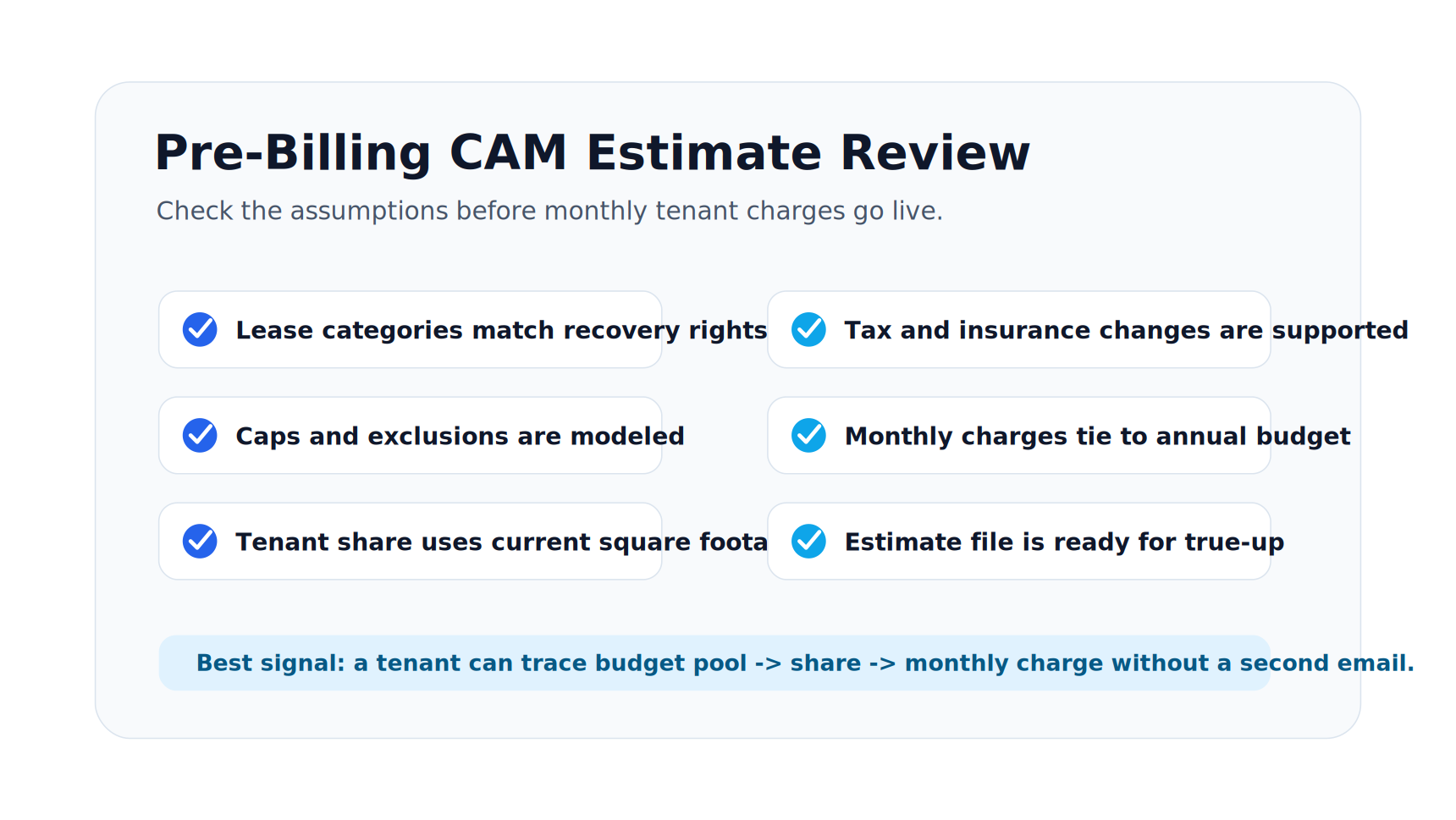
> A good CAM estimate should let a tenant trace the path from budget category to monthly billing amount without asking for a custom explanation.
Show Caps and Exclusions Before Billing Starts
Lease caps should not be discovered during reconciliation.
If a tenant has a cap on controllable expenses, model the cap when setting the estimate. Keep taxes, insurance, utilities, snow, or other uncapped categories separate if the lease treats them differently.
For example, a tenant's lease may cap controllable CAM increases at 5% annually but exclude taxes and insurance from that cap. If the landlord blends all expenses into one line, it becomes harder to prove that the cap was applied correctly.
A cleaner estimate separates the logic:
| Budget component | Estimated amount | Cap treatment | | --- | ---: | --- | | Controllable CAM | $82,000 | Subject to 5% cap | | Property taxes | $41,500 | Uncapped | | Insurance | $29,000 | Uncapped | | Tenant-specific repair | $0 | Excluded from pool |
This does not have to be complicated. It just has to be documented before billing begins.
!Checklist graphic for reviewing CAM estimate assumptions before tenant billing begins.
Convert the Estimate Into Monthly Tenant Charges
After the tenant's estimated annual share is calculated, convert it into monthly charges.
A simple summary should include:
- recoverable budget pool
- tenant pro-rata share
- tenant estimated annual CAM
- monthly estimate
- tax and insurance estimate, if billed separately
- cap or exclusion adjustments
- effective billing date
- responsible approval owner
For example:
| Step | Amount | | --- | ---: | | Recoverable CAM budget | $132,000 | | Tenant pro-rata share | 7.25% | | Tenant annual CAM estimate | $9,570 | | Monthly CAM estimate | $797.50 |
If taxes and insurance are billed as separate monthly lines, show them separately. Tenants and internal teams should be able to tell what the charge represents without decoding an old workbook.
Communicate Material Changes Early
Large estimate changes should not appear on the invoice without context.
If a tenant's monthly CAM estimate is increasing from $650 to $825, send a short explanation with the new schedule. The note should focus on the drivers:
- insurance renewal increase
- tax assessment change
- new service contract
- major recurring maintenance
- vacancy assumption
- correction to square footage or allocation pool
This is not a marketing message. It is operating discipline. A tenant who understands the estimate in January is less likely to treat the reconciliation in March of the following year as a surprise bill.
The same applies when estimates decrease. If the landlord removed a one-time repair or changed the allocation pool, document it. The record will help when actuals are compared to estimates later.
Keep an Estimate File for the Future True-Up
Every annual CAM estimate should leave behind a file that the year-end reconciliation can use.
That file should include:
- final approved budget
- lease rule summary by tenant
- tenant square footage and denominator
- pro-rata share calculation
- cap and exclusion notes
- monthly billing schedule
- variance assumptions
- tax and insurance support
- vendor contract support for major categories
- approval notes
This estimate file becomes the starting point for the true-up. When actuals arrive, the landlord can compare actual spend to the same categories and assumptions used for the estimate.
Without that file, the team has to reconstruct why a number was chosen months earlier. That is how CAM work becomes fragile.
Where PigJet Fits
PigJet is built for the part of commercial property management that sits between accounting, lease administration, and tenant communication.
For landlords using QuickBooks, the accounting system can remain the source of invoices, expenses, and payments. PigJet helps organize the commercial context around those numbers: which lease rules apply, how tenant shares are calculated, how CAM estimates connect to actuals, and what the tenant should see when questions come up.
That matters because annual CAM estimates are not isolated charges. They are the first chapter of the reconciliation story. If the estimate is documented well, the true-up is easier to defend. If the estimate is a copied-forward spreadsheet, the true-up starts with weak assumptions.
A Practical Annual CAM Estimate Workflow
Use this sequence before billing the new year's CAM estimates:
1. Confirm each tenant's lease recovery rules. 2. Build the recoverable property budget by category. 3. Remove excluded or tenant-specific expenses. 4. Separate capped and uncapped categories. 5. Update square footage and pro-rata share calculations. 6. Model tax, insurance, and volatile category assumptions. 7. Calculate monthly tenant estimates. 8. Review large changes before billing starts. 9. Save the estimate file for year-end reconciliation. 10. Communicate material changes to tenants in plain language.
The process is straightforward, but it forces the right questions early.
Annual CAM estimates do not need to be perfect. They need to be reasonable, lease-compliant, and traceable. When landlords build estimates that way, year-end reconciliation becomes less about defending surprises and more about closing the loop between budget, actuals, and tenant billing.