A Vacancy Report Built for Commercial Property Management
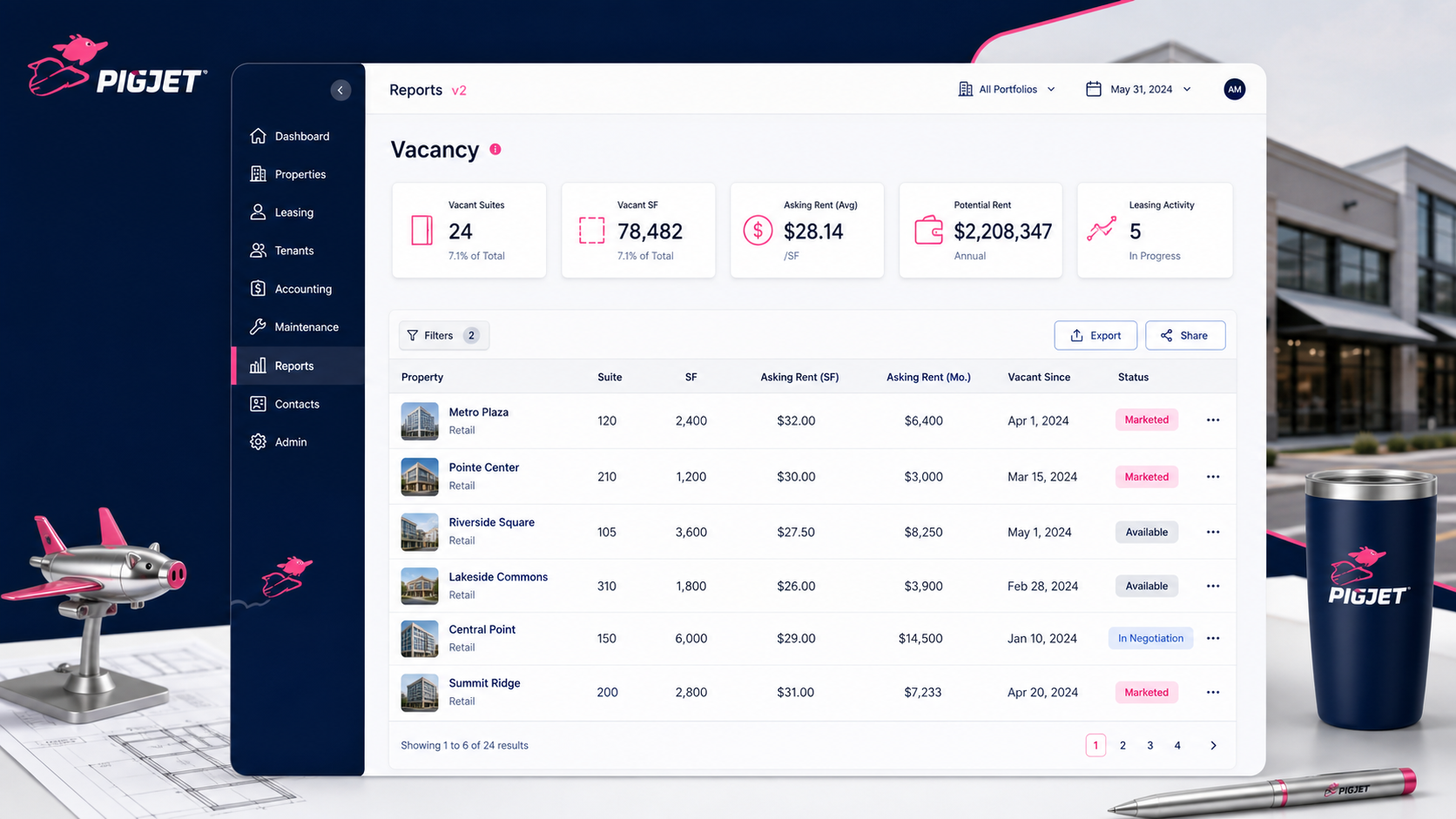

Vacancy tracking is one of those commercial property management jobs that looks simple until the portfolio has more than a few open suites.
One vacant unit may be in a broker flyer. Another may be in a leasing spreadsheet. A third may have an asking rate in the rent roll but a different note in an email thread. Ownership asks for the current availability list before a weekly call, and someone has to rebuild the same report again.
That is the workflow PigJet's new Vacancy report is meant to tighten up. The report pulls vacant suites into one portfolio-wide view with the details landlords and leasing teams need first: status, asking rent, rentable square footage, property context, and export-ready rows.
This post is based on PigJet's released Vacancy report in Reports v2, shipped in PR 260 and published in the product changelog as `vacancy-report`.
Why Vacancy Reporting Gets Messy
Commercial vacancy is not just a leasing problem. It touches cash flow, CAM budgeting, broker communication, lender reporting, and owner updates.
When the vacancy list is not current, the mistakes are practical:
- an old asking rate makes it into a leasing call
- a suite is marked available even though a proposal is active
- rentable square footage differs between the flyer, rent roll, and budget workbook
- ownership sees a stale vacancy count
- the team exports a custom spreadsheet that is obsolete a week later
For NNN and retail landlords, the vacancy list also connects to reimbursement planning. Empty suites can affect CAM estimates, gross-up assumptions, utility exposure, property tax recovery, and the story behind NOI movement. A vacancy report is not only a marketing inventory list. It is part of operating the property.
What PigJet Added
PigJet now includes a dedicated Vacancy tile inside Reports. The report brings vacant suites into the same reporting hub used for other portfolio views, so the availability list is no longer a separate manual artifact.
The report focuses on the basics first:
- vacant suite count
- rentable square footage
- asking rate
- vacancy status
- property and suite context
- search, sort, density, refresh, and share controls
- one-click Excel export
Each row can open a read-only summary drawer. From there, the operator can jump into the existing vacancy editor when a detail needs to be corrected.
That matters because reports should not become dead-end screenshots. If the person reviewing vacancy sees a wrong status or outdated asking rent, the workflow should point back to the system of record instead of creating another spreadsheet comment thread.
The Customer Problem It Solves
Most small and mid-sized commercial owners do not need a massive leasing CRM just to answer basic vacancy questions.
They need to know:
- what is vacant
- what is being marketed
- what asking rate is being used
- how much rentable square footage is open
- which spaces need follow-up
- what they can send to a broker, partner, or lender today
When those answers live in several places, the landlord pays for it in review time. Someone reconciles broker notes against property records, then rebuilds the same table for every meeting. The report may be useful, but the process is not repeatable.
PigJet's approach is to make vacancy a normal operating report. The same property and suite records that run the portfolio also drive the vacancy list. The export is there when a lender, broker, or owner wants a file, but the export is not the source of truth.
Why It Belongs in Reports
Putting vacancy inside Reports v2 changes the workflow in a small but important way.
Instead of treating vacancies as an exception list, PigJet treats them as part of portfolio reporting. A landlord can review occupancy, rent roll, lease deadlines, insurance, and vacancy from the same reporting surface.
That helps during recurring operating meetings. A vacancy discussion usually turns into adjacent questions:
- Which tenant moved out?
- Is the suite already being marketed?
- What asking rate are we quoting?
- Does the vacancy affect the CAM estimate?
- Are there open make-ready tasks?
- Do we need to update ownership or a lender?
The Vacancy report does not try to replace every leasing system. It gives the landlord a clean operating view that can feed those conversations without starting from a blank spreadsheet.
What To Check Before a Leasing Call
If you are reviewing commercial vacancy weekly or monthly, the report should answer five questions before the meeting starts.
1. Is every vacant suite accounted for?
The most basic failure is missing inventory. If a space is vacant but does not appear on the list, the rest of the report cannot be trusted. Check property-by-property and make sure every open suite has a current status.
2. Is the asking rent current?
Asking rent changes as brokers test demand, concessions shift, or ownership decides to prioritize occupancy. A vacancy report should show the current number the team is using, not last quarter's placeholder.
3. Is the status useful?
"Vacant" is not enough. A suite that is being marketed, under LOI, in negotiation, held for a known expansion, or waiting on make-ready work should not be treated the same way. Status is what makes the list operational.
4. Can the team export it without cleanup?
If the report needs 30 minutes of formatting before it can be sent to a broker or ownership group, the system is not doing enough work. Export should be a handoff, not a rebuild.
5. Can errors be corrected at the source?
The best vacancy report still depends on good underlying records. When a detail is wrong, the workflow should take the operator back to the suite or vacancy editor so the correction carries forward.
How This Fits PigJet's Product Direction
PigJet is built around the work commercial landlords repeat: lease records, CAM recovery, QuickBooks-connected billing, tenant communication, and portfolio reporting.
The Vacancy report fits that direction because it turns a common owner question into a live operating view:
> What is vacant right now, what are we asking, and what can I send to the team?
That is not a theoretical analytics problem. It is a weekly workflow problem. A landlord should not need to hunt through emails, broker PDFs, and spreadsheets to answer it.
For owners managing NNN retail, mixed-use, or small commercial portfolios, vacancy reporting becomes more useful when it sits next to the lease and financial context. A vacant suite affects more than the leasing pipeline. It affects forecasts, CAM assumptions, make-ready work, and the questions ownership will ask at the next review.
PigJet's Vacancy report is a step toward making that operating picture easier to maintain.
Bottom Line
Vacancy reporting works best when it is current, exportable, and tied back to the property records that drive the rest of the portfolio.
PigJet's new Vacancy report gives commercial landlords one place to review open suites, asking rent, rentable square feet, and status without rebuilding a spreadsheet from scratch. It is a practical product update for a practical problem: knowing what is available and keeping the team aligned on what happens next.
If vacancy tracking is still split between a rent roll, broker notes, and a weekly spreadsheet, that is a good workflow to test when evaluating commercial property management software or a one-property PigJet pilot.