Rent Escalation Tracking for NNN Leases: How Landlords Stop Missing Step-Ups
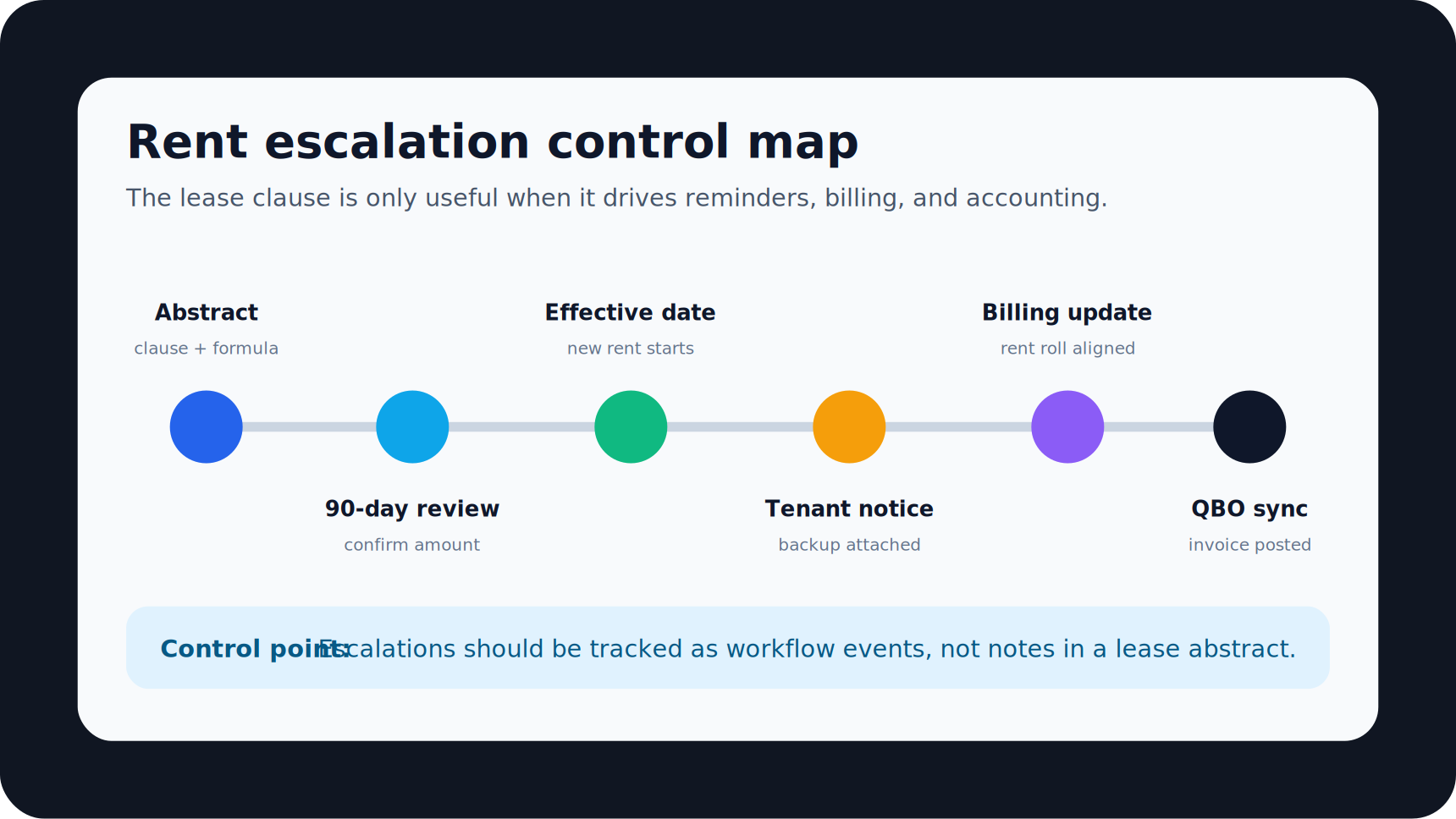

Rent escalation tracking sounds like a calendar problem. Put the date in a spreadsheet, set a reminder, and increase the rent when the lease says to increase it.
That works until the portfolio has amendments, CPI language, option periods, percentage bumps, notice requirements, and a bookkeeper who needs the new charge in QuickBooks before invoices go out.
For NNN landlords, rent escalation tracking is not just about remembering a date. It is about keeping the lease clause, the effective date, the new rent amount, the tenant communication, the rent roll, and the accounting entry aligned.
Miss one of those handoffs and the landlord either leaves money on the table or sends a confusing bill the tenant can reasonably question.
Why Rent Escalations Get Missed
Most missed escalations are not caused by a landlord forgetting that rent goes up. They are caused by weak operating controls around lease data.
A lease abstract may list "3% annual increases," but not show whether the increase starts on the anniversary date, the first day of the next calendar year, or the first day of the next lease year. A spreadsheet may have the right date, but not the amendment that changed the commencement date. A calendar reminder may fire, but nobody updates the rent roll before the monthly invoice batch.
The risk is higher in NNN portfolios because rent is not the only recurring charge. Base rent, CAM estimates, tax recoveries, insurance charges, and annual true-ups may all appear on the tenant ledger. If base rent changes but the billing workflow is not updated cleanly, the error can hide inside an otherwise busy monthly statement.
The Main Types of Commercial Rent Escalations
Most commercial leases use one of several escalation structures. Each one creates a different tracking problem.
Fixed Percentage Bumps
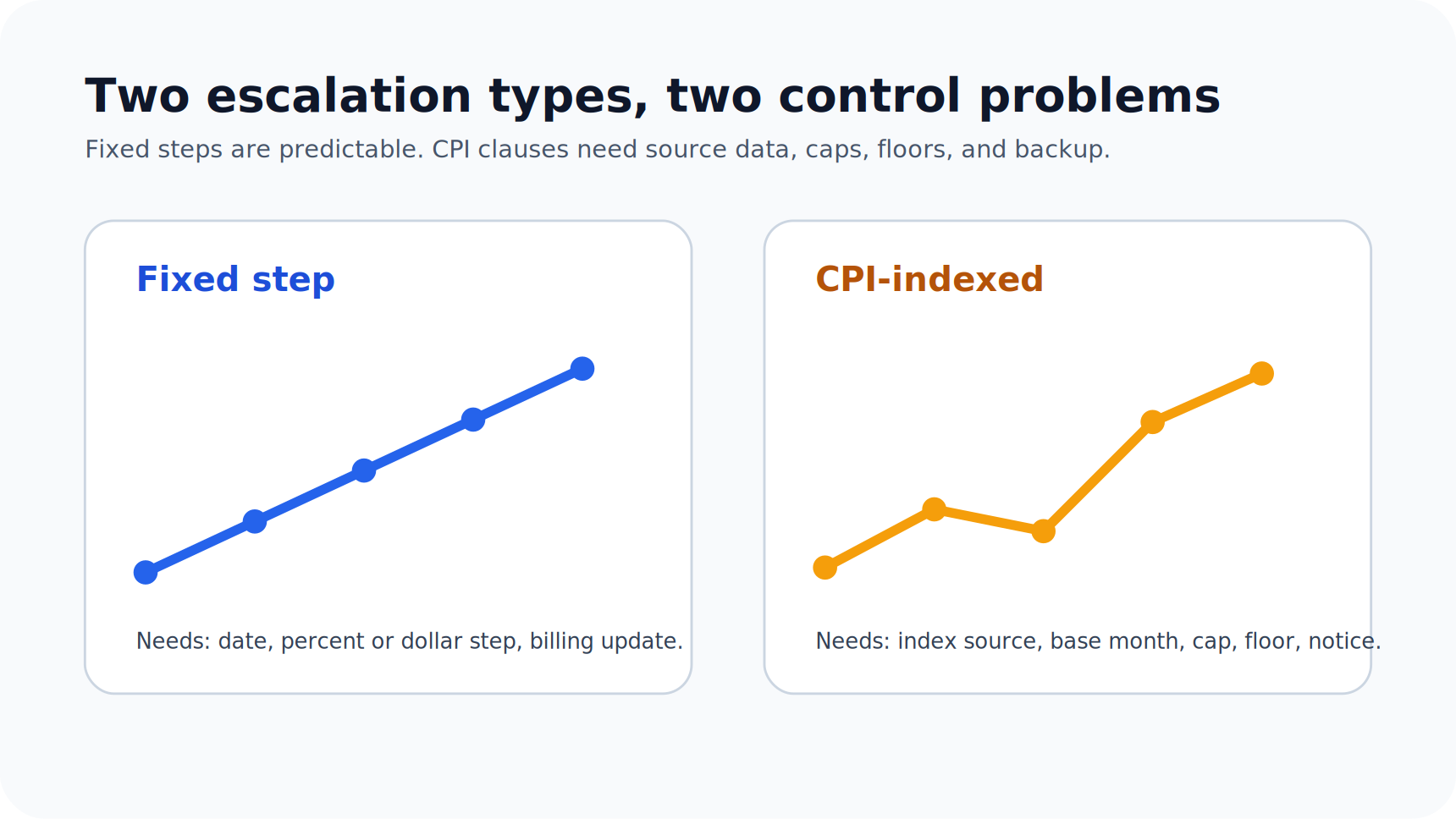
A fixed percentage bump is the easiest structure to administer. The lease might say base rent increases by 3% every year on the anniversary of the rent commencement date.
The control issue is precision. The landlord needs the exact start date, the current rent amount, the percentage increase, and the correct rounding method if the lease specifies one.
Fixed Dollar or Per-Square-Foot Steps
Some retail and office leases use a schedule such as `$24.00/SF in year one`, `$24.75/SF in year two`, and `$25.50/SF in year three`.
This is usually predictable, but it still has to connect to the suite size and billing cadence. A small square footage error can turn into a recurring monthly billing error.
CPI-Indexed Escalations
CPI clauses are more operationally sensitive. They may reference a specific index, a base month, a comparison month, a cap, a floor, and a notice requirement. The landlord may not know the final increase until the relevant CPI data is available.
The tracking system needs more than a date. It needs the formula, the index source, backup documentation, and a workflow to send the tenant the calculation.
Market Rent or Appraisal-Based Adjustments
Some renewal terms reset rent to fair market value. These are less like routine billing changes and more like project workflows. They may involve broker input, appraisal procedures, negotiation windows, and ownership approval.
For these clauses, the internal deadline should be much earlier than the contractual effective date.
What to Track for Every Escalation
A useful rent escalation tracker should include:
- Property
- Tenant
- Suite
- Lease source and amendment source
- Current base rent
- New base rent or formula
- Effective date
- Internal review date
- Tenant notice requirement
- Required backup or calculation worksheet
- Rent roll update status
- Invoice or billing template update status
- QuickBooks posting status
- Person responsible
- Completion date
That list may feel heavy if you only manage one lease. It becomes normal once you manage several tenants across different properties. The point is to keep the escalation from becoming a memory task.
The 90-Day Review Window
For fixed-step escalations, a 30-day reminder may be enough. For CPI, market rent, or renewal-based increases, 90 days is safer.
A 90-day review gives the landlord time to:
- Confirm the active lease and amendments
- Verify whether the tenant exercised or waived any option
- Calculate the new amount
- Check caps, floors, and rounding rules
- Prepare tenant notice if required
- Update rent roll and accounting setup before invoices run
The review date is not the legal deadline. It is the operating deadline that keeps the legal deadline from becoming urgent.
Tenant Notice Should Not Be an Afterthought
Some leases require written notice before an escalation applies. Others do not require notice but tenants still expect backup, especially for CPI increases or more complex step schedules.
Good escalation administration keeps tenant communication attached to the rent change. The notice should explain the effective date, the calculation method, the old rent, the new rent, and where the lease authorizes the change.
This matters because tenant disputes often come from surprise, not just disagreement. If the tenant sees an unexplained increase on a statement, the property team has to reconstruct the logic after the fact. If the notice and backup are already saved, the conversation is shorter and cleaner.
Month-End Controls for Rent Escalations
Rent escalations usually fail at month-end because lease administration and accounting are separate workflows.
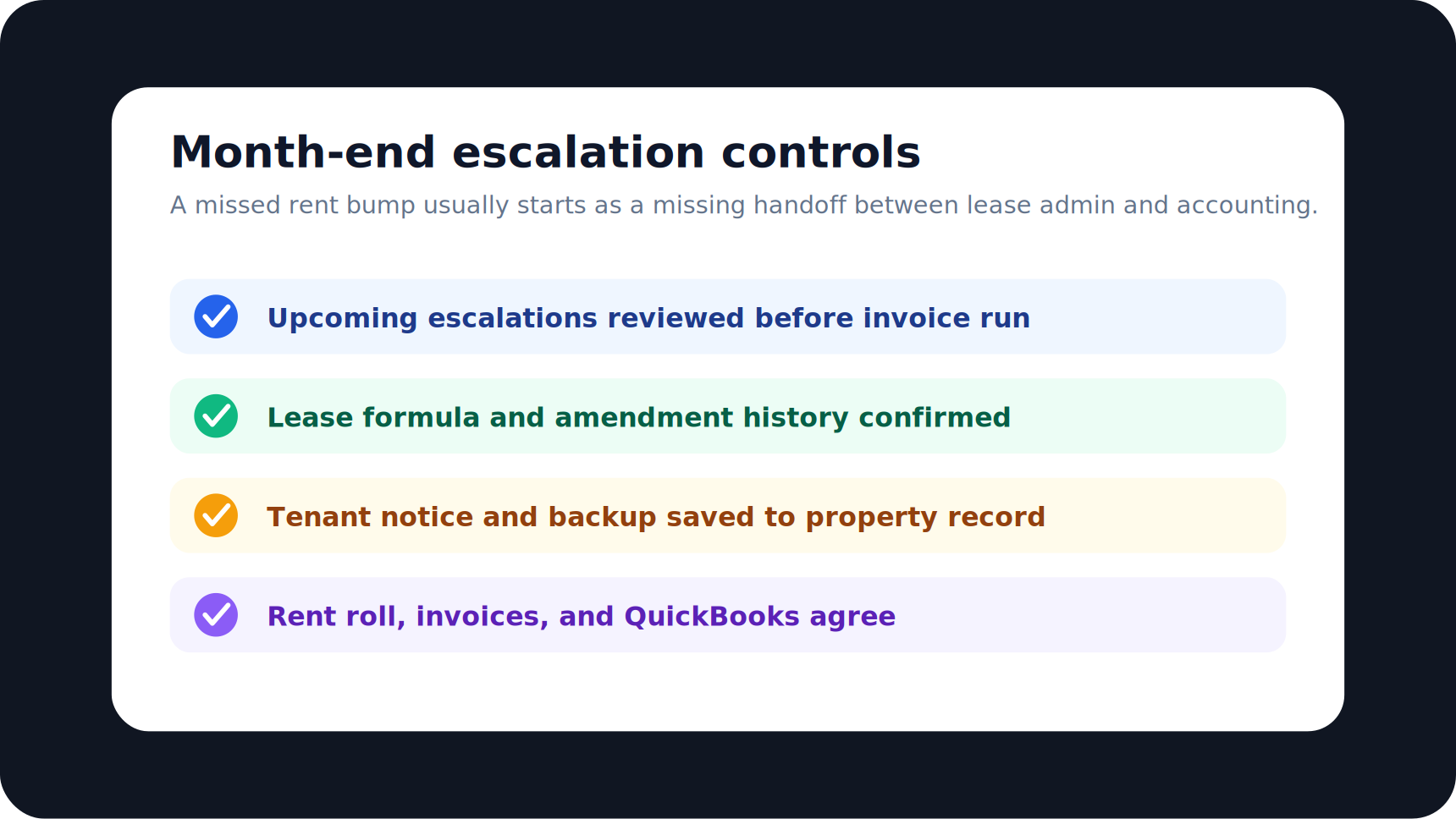
Before invoices are generated, the landlord or manager should confirm:
- Which escalations become effective in the next billing cycle
- Whether every rent roll amount reflects the current lease term
- Whether tenant notices have been sent where required
- Whether QuickBooks invoices or recurring charges match the rent roll
- Whether any CAM estimate, tax, or insurance charge is affected by the same amendment
The last point is easy to miss. A lease amendment may change base rent, extend the term, adjust recovery language, and reset option dates. Treating the escalation as a standalone rent number can leave the rest of the operating record stale.
Why Spreadsheets Break Down
Spreadsheets are a reasonable starting point, but they become fragile for three reasons.
First, they separate the date from the clause. Someone sees "increase on 7/1" but cannot see the lease language, CPI formula, notice method, or amendment history.
Second, they rely on manual handoffs. One person updates the spreadsheet, another updates billing, another posts to QuickBooks, and nobody has a single completion state.
Third, they do not connect escalations to related events. A renewal option may create a new rent schedule. A suite expansion may change rentable area. A CAM estimate letter may need to be updated alongside base rent.
The problem is not that spreadsheets are bad. The problem is that rent escalation tracking is a workflow, and spreadsheets are usually used as static lists.
How PigJet Handles the Workflow
PigJet is built for the operating work that sits between a commercial lease and the accounting system.
For rent escalations, that means the lease abstract, escalation schedule, reminders, rent roll, tenant backup, and QuickBooks handoff can live together. A fixed step does not sit in a note field waiting for someone to remember it. A CPI clause is tracked with the formula and supporting details needed to calculate and explain the increase.
That is the practical difference: the landlord does not just store the lease term. The landlord can operate from it.
If you want to model the math first, PigJet's rent escalation calculator is a useful place to test fixed-step and percentage scenarios. For broader lease administration, see the commercial lease abstraction guide and NNN lease management software guide.
Bottom Line
Rent escalation tracking protects recurring revenue. For NNN landlords, it also protects trust in the monthly statement.
A good process does four things: finds the active lease clause, calculates the new rent correctly, tells the tenant what changed, and updates accounting before invoices go out.
If those steps live in separate places, missed escalations are only a matter of time. If they are connected, rent bumps become a routine control instead of a recurring scramble.