The Property Timeline Problem: Yardi, Outlook, Trello, and Memory
One of the most important commercial property software problems is not really about CAM.
It was about reconstruction.
The operating stack was familiar: accounting software for accounting, a task tool for maintenance, Outlook for communication history, and then a lot of manual work when someone needs to understand what happened at a property.
That is the property timeline problem.
The data exists. The story is scattered.
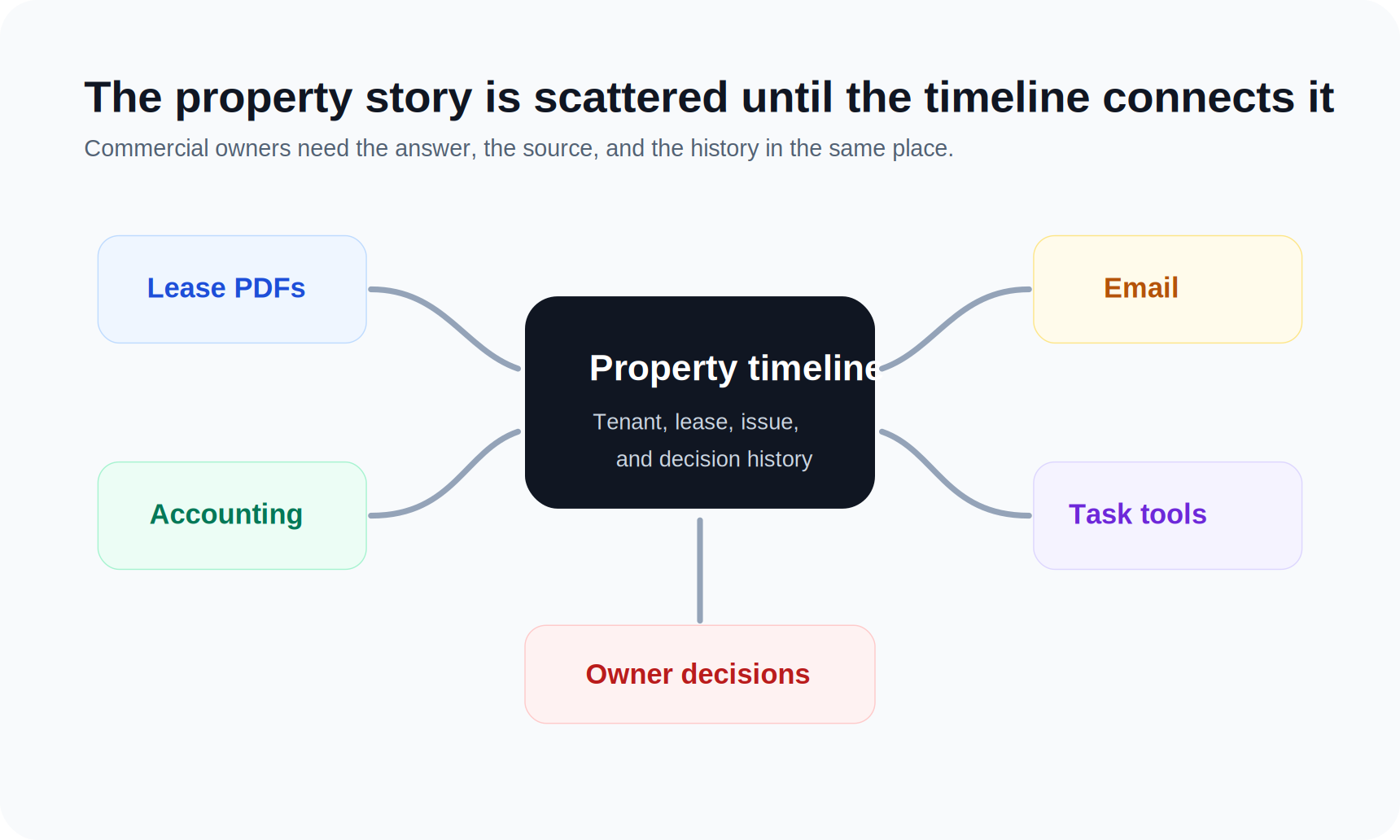
The answer is usually somewhere
Most commercial owners have the information somewhere.
The lease is in one place. The tenant emails are in another. The maintenance task is in a task tool. The invoice is in accounting. The notice may be in someone's sent folder. The reason a decision was made may live in a property manager's memory.
That works until someone asks a simple question:
What happened here?
A tenant disputes a balance. An attorney asks for history. An owner wants to know whether the vendor followed up. A manager needs to understand a parking, HVAC, signage, or ledger issue from last year.
The team can usually find the answer. The cost is time.
That cost is easy to underestimate because it rarely appears as a single line item. It shows up as an hour here, three emails there, a delayed response, a tenant who loses confidence, a manager who has to ask the same question twice, or an owner who cannot tell whether the property manager is on top of the issue.
A ledger is not a timeline
Accounting software is important, but it usually does not tell the whole story.
A ledger can display a balance. It may not display the tenant's objection, the lease clause, the prior notice, the maintenance note, the vendor response, or the email where someone promised to send backup.
A task board can display work. It may not display the rent implication, lease issue, or communication history.
Email has context, but it is hard to structure.
Commercial owners need those pieces connected by property, tenant, and issue.
This is especially true in NNN retail because one issue can touch several workflows. A tenant balance may require a lease review and a notice. A maintenance dispute may affect CAM. A vendor invoice may need to be tied to a reimbursement category. A tenant email may become important when the same tenant pushes back during reconciliation. A property manager's update may matter later when an owner is evaluating whether to renew a lease, approve work, or escalate collections.
If those pieces live in separate tools, the owner is always one question away from a manual search.
This gets harder as the portfolio grows
At two or three properties, an owner can often remember the story. At ten or twenty, that breaks down. At one hundred-plus properties, the property history has to be a system, not a person.
That becomes obvious when owners are dealing with internal management teams. Others had third-party managers. Others were modernizing family-office operations where documents, finance workflows, and property history had accumulated over years.
The common problem was not a lack of effort. It was lack of connected context.
Portfolio growth makes this worse because the number of small exceptions grows faster than the number of properties. Each tenant has a different lease. Each lease has different obligations. Each property has different vendors. Each issue creates emails, invoices, tasks, and decisions. Eventually, the owner does not need more memory. The owner needs a timeline.
The property timeline should be practical
A property timeline does not need to be complicated.
It should answer basic questions quickly:
- What did the tenant ask?
- What does the lease say?
- What did we send back?
- What is the open balance?
- What vendor or manager is involved?
- What documents support the answer?
- What still needs next-step?
That sounds simple, but it is not how many commercial portfolios operate today. The operating history is split across accounting, email, spreadsheets, document folders, task boards, and people's heads.
The goal is not to replace every existing tool immediately. The goal is to make the property story usable.
Communication history is where timelines usually fail
The hardest part of the timeline problem is often not accounting or maintenance. It is communication.
Tenant communication rarely stays clean. One email asks about a balance. Another asks about a maintenance issue. A broker gets copied. A vendor responds separately. A manager forwards part of the thread. Someone sends a notice. Someone else replies by phone. Months later, the owner needs to know what actually happened.
If that history is only in email, the property record is fragile.
This matters because communication is evidence. It shows when the tenant was told something, what the owner promised, what the manager followed up on, and whether an issue was resolved or ignored. During a dispute, renewal, sale, refinance, or manager handoff, the communication trail can matter as much as the ledger.
The timeline should survive turnover
Commercial portfolios often depend too much on individual memory.
That is fine until the property manager changes, the controller leaves, the owner's assistant moves on, or the third-party manager gets replaced. Then the new person inherits folders, email threads, spreadsheets, and shorthand that made sense only to the prior team.
A real property timeline should survive that turnover.
The new person should be able to open the property, see the active tenants, understand the lease obligations, review open balances, see recent notices, check maintenance history, and follow the communication trail. They should not have to call three people to learn why a tenant is upset or why a reimbursement was handled differently last year.
That kind of continuity is not glamorous, but it is one of the most valuable things software can provide to a private owner.
The owner view should be different from the manager view
Another reason timelines matter is that owners and managers often need different levels of detail.
The manager may need the task list. The accountant may need the ledger. The owner may need the decision trail: what happened, why it matters, what is still open, and whether there is risk. A good property timeline should let each person work from the same facts without forcing everyone into the same view.
That is especially useful when a portfolio uses outside managers. The owner does not need to micromanage every work order, but they do need enough visibility to understand lease issues, tenant disputes, aging balances, and open follow-ups.
The owner view also needs to connect old and new information. A lease signed years ago, a tenant email from last quarter, and a current balance may all be part of the same issue. If the timeline only starts when a new system is installed, the owner still has to keep the old context somewhere else. A useful system should help bring the relevant history forward without pretending the past was clean.
What PigJet should help with
PigJet should make the property timeline usable.
That means the owner can move from tenant to lease to balance to notice to maintenance issue to next-step without rebuilding the file from scratch. It also means a property manager, accountant, owner, or advisor can understand the same history without calling the one person who remembers it.
The goal is not to replace every tool on day one.
The goal is to stop losing the story of the property.
If a commercial owner can answer "what happened here?" without opening five systems and searching old email, the software is doing real work.