The One-Property Pilot Is the Cleanest Way to Modernize a CRE Portfolio
Most commercial owners do not need a dramatic software migration to know whether a tool is useful.
They need one property.
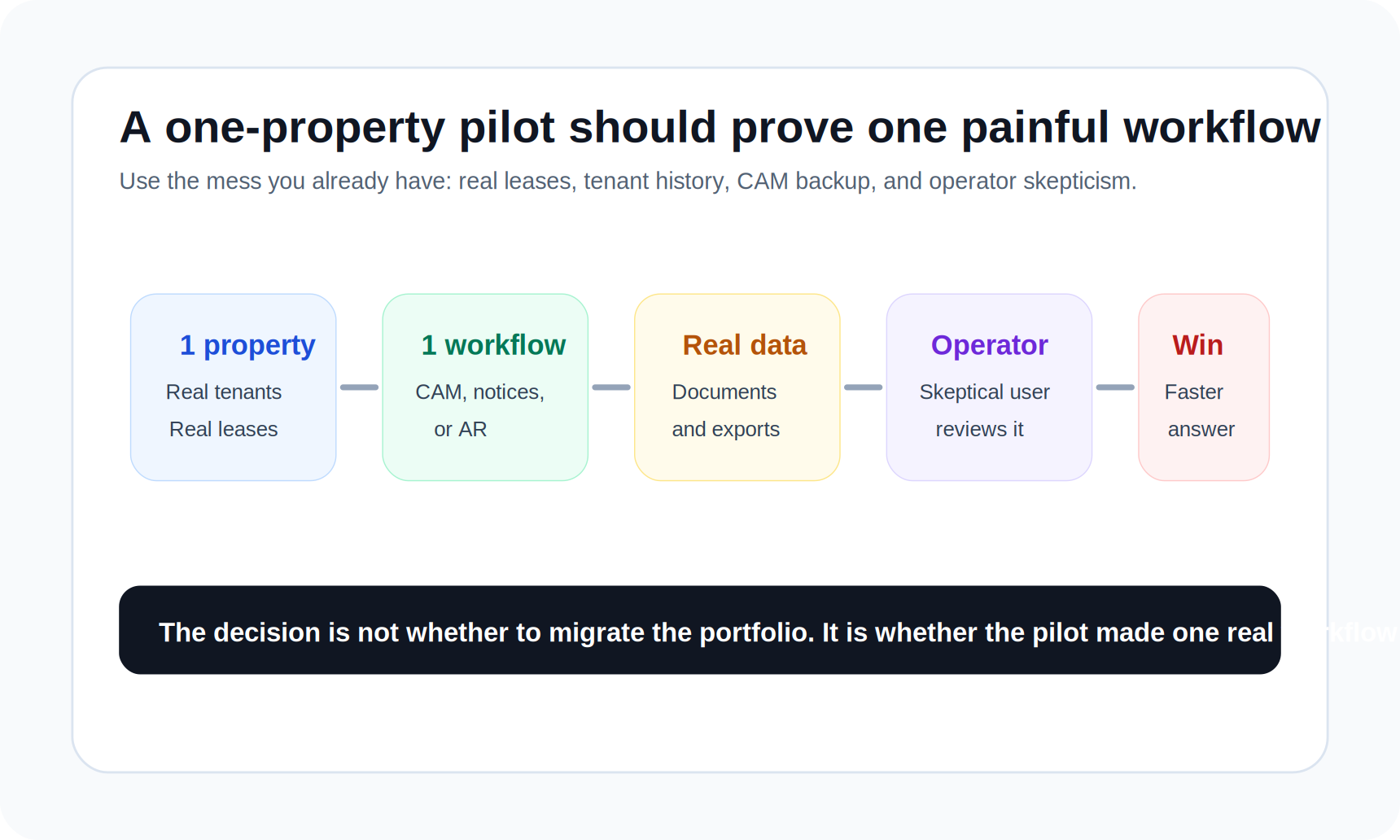
That is one of the most consistent patterns in successful software evaluation. Whether the owner is on an enterprise platform, a third-party manager, QuickBooks, Excel, a legacy system, or a custom internal workflow, the best next step is usually the same: pick one real property and one annoying workflow.
Then test it honestly.
Big migrations create unnecessary fear
Commercial portfolios are messy for good reasons.
Accounting has to keep running. Property managers already have habits. Controllers are rightly cautious. Third-party managers may be involved. Some systems are painful but still important. Some owners dislike their accounting workflow but still have accountants who will fight any change. Some are staying with an enterprise system and only need help around the edges.
A platform that starts with "move everything" asks for too much trust too early.
A one-property pilot lowers the risk.
It also matches how many owners actually make decisions. They do not want a theoretical answer about whether software could run the whole portfolio. They want to see whether it can handle one real property with real documents, real tenants, and real mess.
The pilot should use real data
The pilot should not be a clean sample file.
It should use the actual lease, actual tenant list, actual CAM statement, actual accounting export, actual insurance certificate problem, or actual past-due workflow.
Real operator examples suggest several good pilot shapes:
- One multi-tenant retail center with messy CAM.
- A newer or smaller property that will not threaten the whole portfolio.
- A few restaurant leases with options, escalations, CAM worksheets, taxes, and sales reporting.
- A collections workflow with accounting included.
- A third-party manager relationship where the goal is visibility, not replacement.
Those are practical tests.
A pilot using real data exposes the right problems early. Are the leases organized? Are the tenant names consistent? Does the accounting export line up with the property structure? Are CAM categories clear? Are insurance certificates current? Does the owner know where notices are stored? Can the team explain a tenant balance without calling three people?
That is the point.
A pilot should answer one question
The question is not "does this product have every feature?"
The question is: does it make this workflow easier?
Can the team answer lease questions faster? Can CAM rules be explained? Can tenant notices and follow-ups stay tied to the property? Can AR/AP context sit next to the lease and tenant history? Can the owner see what is going on without calling three people?
If the answer is yes on one property, then there is a reason to expand.
If not, the owner avoided a bad rollout.
That discipline matters because commercial software evaluations can sprawl. Everyone has a wishlist. Accounting wants one thing. Asset management wants another. Property management wants another. Ownership wants visibility. Brokers want lease dates. The controller wants clean data. The team can spend months defining a perfect future state and never test the actual workflow.
One property cuts through that.
The pilot does not have to threaten the current stack
A good pilot can sit next to what the owner already uses.
If accounting stays in the current system, the pilot can focus on lease/CAM rules, tenant communication, notices, or owner visibility. If a third-party manager stays in place, the pilot can focus on oversight and reporting. If the team is using spreadsheets, the pilot can focus on replacing only the parts that break during CAM season.
This is important because many owners are not ready for a rip-and-replace conversation. They may never need one. The better question is whether a focused operating layer can make the current workflow less painful.
For owners who want that narrower path, PigJet's one-property pilot is designed around the same principle: prove one real workflow before discussing a broader rollout.
The pilot should include the skeptical person
Every portfolio has someone who knows where the bodies are buried.
Sometimes it is the controller. Sometimes it is the property manager. Sometimes it is the person who builds the CAM spreadsheet every year. Sometimes it is the owner who remembers the renewal history. That person should be part of the pilot.
If the software only impresses the person who is farthest from the daily workflow, the pilot is not complete. The skeptical operator is the one who can point out the real issues: missing documents, bad source data, tenant-specific exceptions, accounting categories that do not map cleanly, or reports that look good but are not actually usable.
That feedback is valuable. It prevents a software decision from being made around a polished demo instead of the actual work.
Start narrow, but do not ignore expansion paths
A one-property pilot should be narrow, but it should not be blind to what comes next.
If the first test is CAM, the owner should still ask how the same property would handle notices, tenant communication, insurance certificates, AP/AR context, and lease dates. If the first test is lease abstraction, the owner should ask how those answers become CAM rules or tenant next-step. If the first test is a collections workflow, the owner should ask how the balance connects to the lease and communication history.
The point is to avoid a giant rollout, not to ignore the broader operating model.
A good pilot proves the first workflow and shows a credible path to the next one. That gives the owner a practical adoption path: start where the pain is sharpest, then expand only if the system earns it.
The first win should be obvious
A good pilot should produce a win the operating team can feel.
Maybe the CAM explanation is cleaner. Maybe a lease question that used to take twenty minutes now takes two. Maybe the owner can see tenant next-step without digging through email. Maybe the team catches a reimbursement issue before the statement goes out.
The first win does not need to be dramatic. It needs to be concrete. That is what gives the team confidence to add the next workflow.
The pilot should create a reusable playbook
The best one-property pilot does more than solve one issue. It teaches the owner how the next property would come online.
What documents are needed? Who needs to review the lease rules? How does accounting data come in? How are tenant communications tied back to the property? Which workflows are ready now, and which should wait?
That playbook matters because modernization is rarely a single event. It is a sequence of practical decisions. A pilot should make the second decision easier than the first.
What PigJet should help with
PigJet should earn trust through one real workflow at a time.
Bring one property, a few leases, and the current process that hurts. If PigJet cannot make that clearer, the conversation should stop there. If it can, the next step becomes a business decision instead of a software pitch.
That is the right buying process for private CRE owners.
The one-property pilot respects the reality of commercial operations: portfolios are complicated, teams are busy, and no owner wants to break a working system just to test a new one. Prove the workflow first. Expand only after the proof is real.