How to Track Rent Escalations and CPI Bumps in NNN Leases
Missed Rent Bumps Are Permanent Revenue Loss
A rent escalation clause in a NNN lease is a contractual right to increase base rent on a scheduled basis. Miss the effective date — even by one billing cycle — and you've forfeited that revenue for good.
Unlike a CAM reconciliation error, a missed rent bump rarely gets recovered. Most leases do not allow retroactive collection of contractual increases the landlord failed to implement. The tenant paid the old amount, the billing records show the old amount, and absent a specific lease provision authorizing back-billing, the landlord has no clean claim for the shortfall.
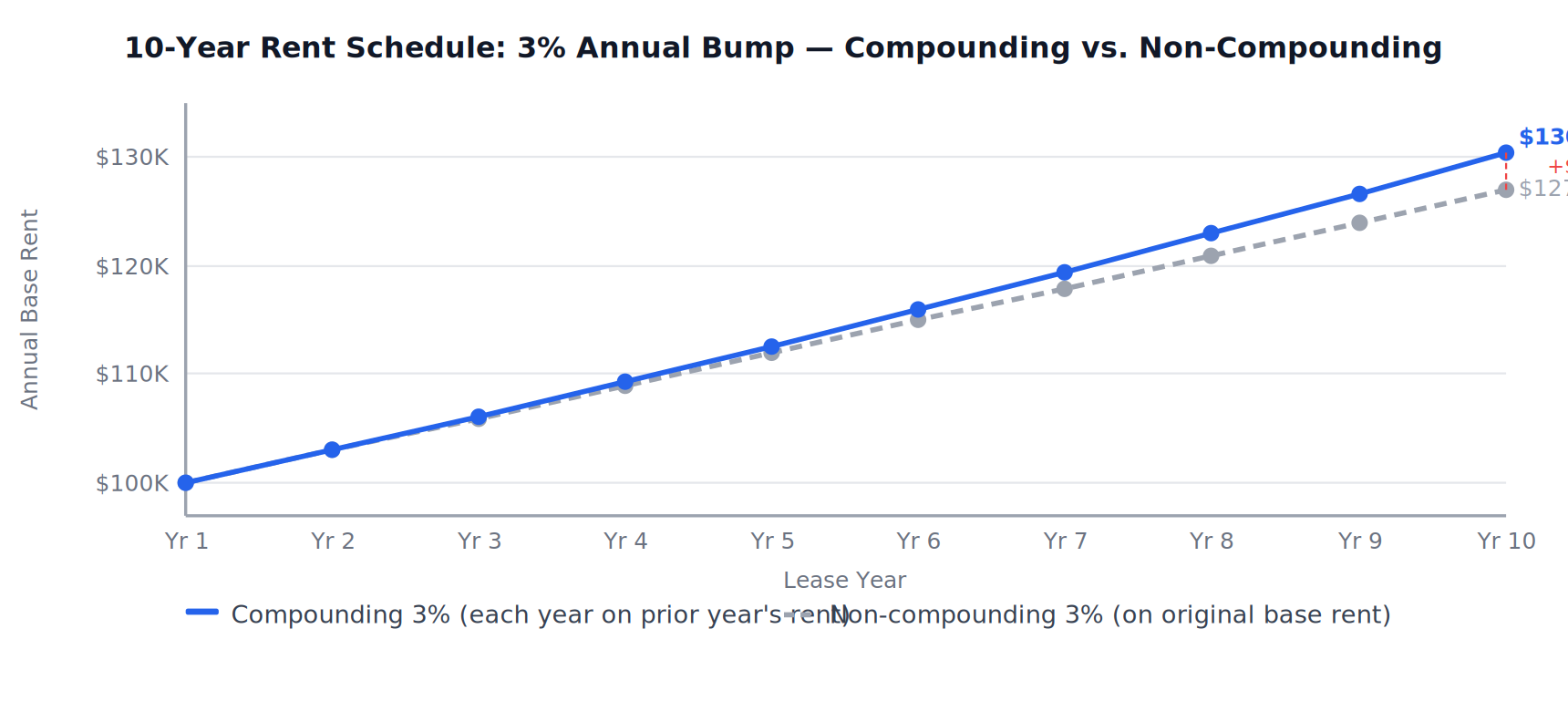
Over a 10-year NNN lease, a single missed year-two increase on a 3% compounding schedule means every subsequent bump starts from a lower base — a gap that reaches $3,400 by year ten on a $100,000 starting rent.
---
Three Escalation Structures, Three Tracking Problems
NNN leases use three common escalation structures, each with a different operating challenge.
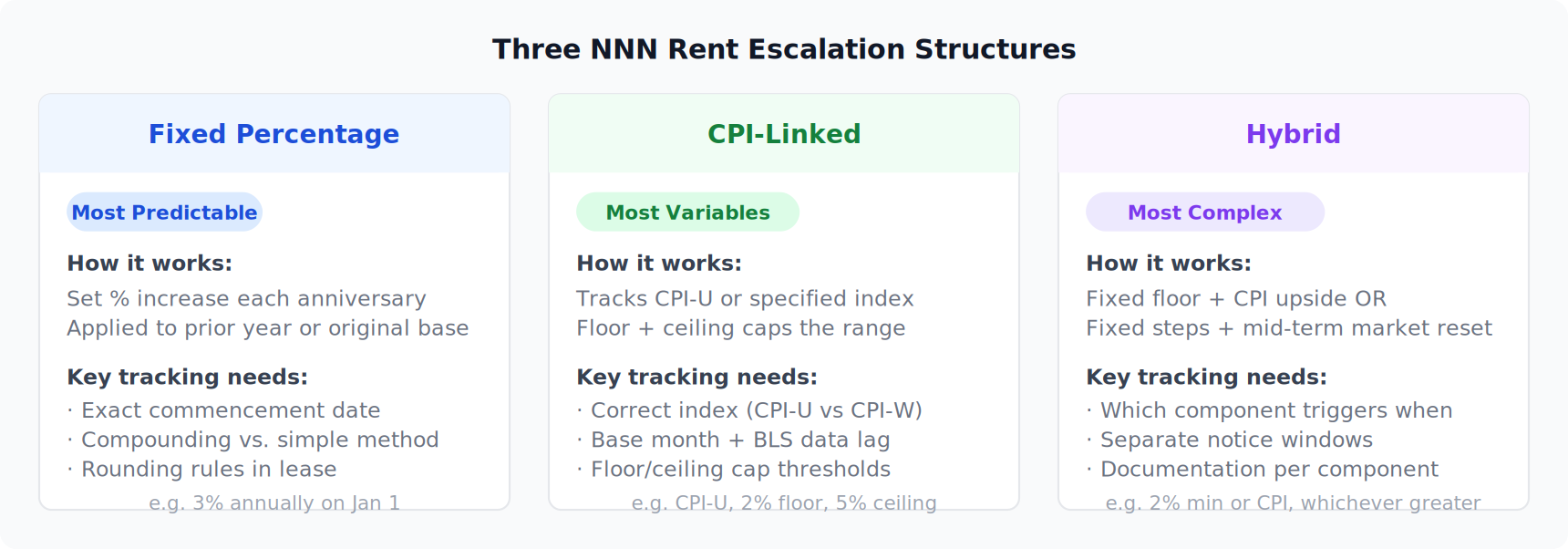
Fixed annual percentage: The lease specifies a set increase — commonly 2% or 3% — on each anniversary of the rent commencement date. The control requirement is precision: exact start date, current base rent, correct percentage, and whether the increase is compounding or simple.
CPI-indexed escalation: Rent adjusts based on a published price index. The lease specifies which index, the base and comparison periods, and usually a floor and ceiling cap. Tracking requires more than a date — the landlord needs the formula, the data publication workflow, and a notice window tied to the calendar.
Hybrid structures: Some leases combine a fixed minimum increase with CPI upside, or a fixed step schedule with a mid-term market rent reset. Different components trigger at different times and may require different documentation.
---
CPI Bumps: The Details That Get Landlords in Trouble
Which index: CPI-U (All Urban Consumers) is the most common reference in commercial leases. Some older leases reference the CPI-W (Urban Wage Earners). A few specify a regional index for a specific metropolitan area. These variants diverge during periods of sector-specific inflation. The landlord must use exactly the index the lease specifies.
Base period and comparison period: A CPI clause might say "compare the CPI for March in the current lease year to March in the prior lease year." The base month is fixed at lease signing; the comparison month is measured annually. The BLS publishes CPI data with a lag of approximately 30–45 days after the reference month, meaning a March comparison requires April data — available mid-April at the earliest.
Notice timing and data lag: If the lease requires 30 days written notice before an escalation takes effect, and CPI data isn't published until mid-April, a May 1 effective date may be unworkable without estimating the index. Map the data release calendar against the notice requirement before the calculation is due.
Floor and ceiling caps: Most CPI clauses include a floor (minimum increase regardless of index movement) and a ceiling (maximum regardless). A common structure is 2% floor, 5% ceiling. In high-inflation periods, the ceiling limits landlord recovery. In flat markets, the floor guarantees a minimum increase even when CPI is near zero. Know where the caps sit — they change the calculation whenever actual CPI falls outside the band.
---
Fixed-Step Schedules: Document the Table at Signing
Fixed-step rent schedules are predictable, but the risk is in documentation: the rent table must be extracted from the lease at signing and kept current through every amendment.
A 10-year retail lease might specify rent year by year: $24.00/SF in year 1, $24.75/SF in year 2, $25.50/SF in year 3. That table needs to live in the lease abstract — not get reconstructed from a PDF later — because amendments can modify the schedule mid-term.
When a lease is amended to extend the term or change the commencement date, the new rent schedule must be reconciled against the old one. Did the amendment restart the step schedule or continue from the current year? Getting this wrong means billing the wrong amount every month until someone catches it.
---
Compounding vs. Non-Compounding: The Math Matters
Non-compounding (simple): Each year's increase applies to the original base rent. A 3% non-compounding increase on $100,000 produces $127,000 by year 10.
Compounding: Each year's increase applies to the prior year's rent. A 3% compounding increase on $100,000 produces $130,477 by year 10 — roughly $3,400 more. The gap starts small and widens through the term.
The lease language to look for: "shall increase by X% over the prior year's Base Rent" indicates compounding; "over the original Base Rent" indicates simple. The difference is not academic — across a portfolio it adds up quickly.
---
What Happens When You Miss a Rent Bump
Revenue forfeiture. Missed increases cannot generally be collected retroactively. The landlord absorbs the shortfall permanently.
CAM calculation errors. In leases where CAM caps or pro-rata adjustments reference the rent roll total, an incorrect base rent creates downstream errors in CAM billing and year-end reconciliations.
Waiver risk. Some courts have treated a pattern of failing to implement contractual escalations as a partial waiver of future rights. The risk is jurisdiction-specific, but a missed bump should be documented and corrected promptly — not silently ignored.
---
Why I Built PigJet
I built PigJet because I missed a rent bump on one of my NNN leases. A 3% annual increase triggered in month 13, and I didn't catch it until the following year's review. Two billing cycles had run at the old rate, QuickBooks invoices were set up incorrectly, and I had to reconstruct the escalation schedule to correct the tenant's statement. It cost hours of cleanup and an awkward conversation.
PigJet tracks rent escalation schedules at the lease level, connected directly to billing. When a rent bump is approaching, the system flags it with enough lead time to confirm the formula, draft the tenant notice, and update billing before the effective date — not three separate tasks that have to be manually linked.
---
Bottom Line
A rent escalation clause is worth tracking correctly. Missing it is not a recoverable error.
For fixed-step leases, the job is accurate documentation and early billing review. For CPI leases, it is knowing the index, the data calendar, the notice window, and the caps before the calculation is due. For hybrid structures, it is keeping the different components clearly separated so nothing falls through.
The landlords who miss bumps are not careless — they are operating with workflows that separate the lease clause from the billing system. Closing that gap keeps the rent roll current and the reconciliations clean.