NNN Pro-Rata Denominator Methods in Mixed-Use Portfolios
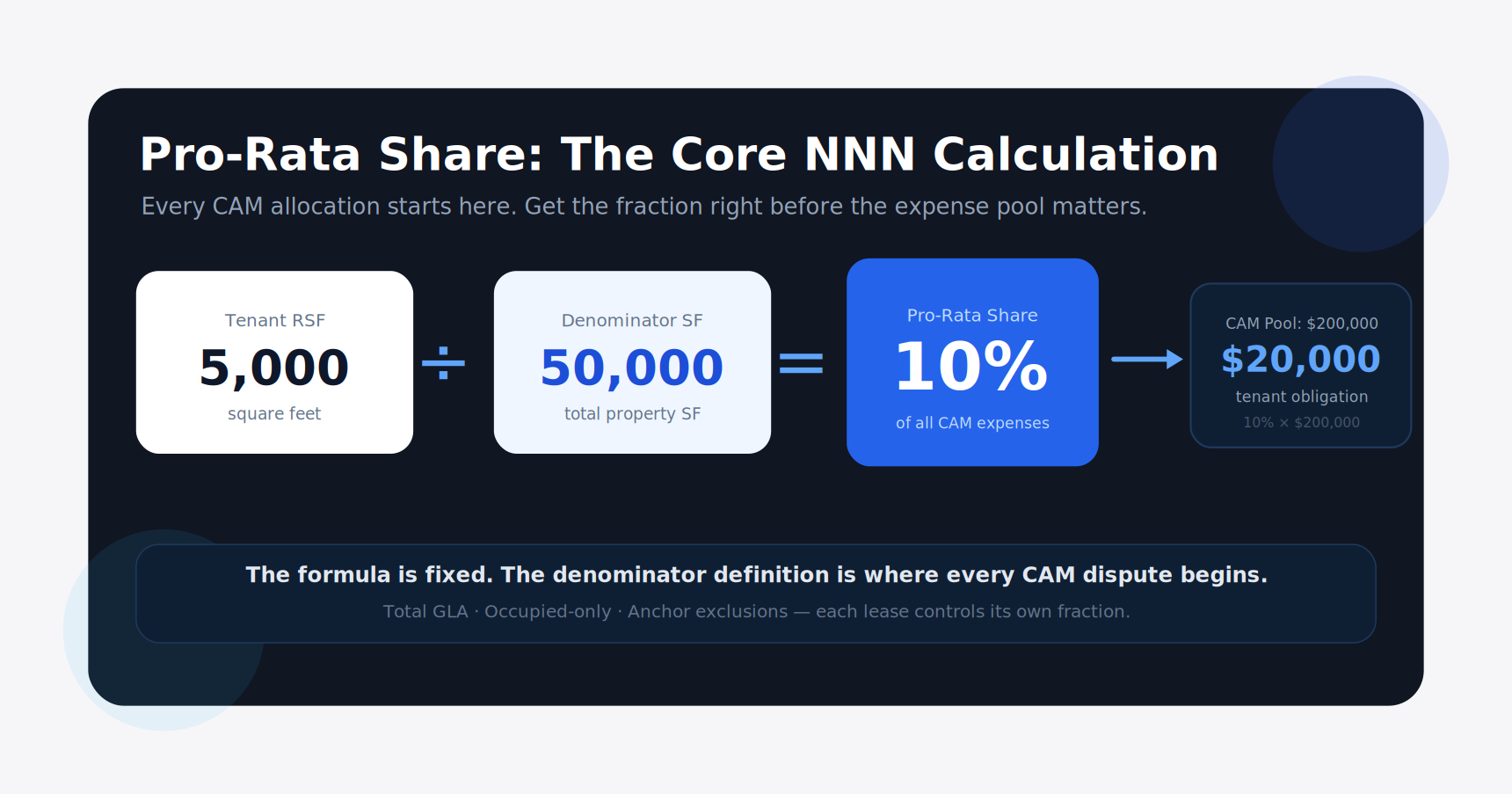

Why Denominator Choices Create CAM Disputes
In mixed-use NNN portfolios, the denominator problem usually appears before the expense problem.
Most owners have a reliable expense list and a tenant list. The break happens when one property uses one pro-rata formula this year and a different formula the next year.
If you are reconciling CAM for a tenant in retail plus small office space, the first question is:
- Do we divide by total rentable area?
- Do we divide by recoverable area only?
- Or do we divide by only area in a lease phase (base year period, sub-metered phase, or only tenant-occupied space)?
Most disputes are not about the underlying math. They are about whether the denominator was pre-defined and consistently applied.
What a Pro-Rata Denominator Actually Controls
For most NNN landlords, CAM recovery is a share of expense:
`Tenant Share = Tenant Recoverable Expense / Denominator`
The numerator is the recoverable expense for the property or cost center. The denominator is the number you divide by.
If you use total building area this year and leased-area only next year, two tenants can appear to owe different charges even if no expense changed.
The denominator should match the lease structure and the operational reality you are calculating. If your lease terms are based on rentable area under active space, dividing by total gross property area can overcharge inactive or non-allocable areas.
Common Denominator Methods
1. Total Rentable Area
This is the easiest method and most often used in simple portfolios.
Formula:
- Tenant recoverable CAM / total rentable area in the property
Use when:
- Property use is relatively uniform.
- Shared cost pools and access points are similar.
- No major free-rent areas or unusable wings distort area.
This method is easier to explain, but it can create pushback when the building has large areas that are not truly part of common-use burdens.
2. Recoverable Area Only
Use only lease zones that should carry CAM obligations.
Formula:
- Tenant recoverable CAM / sum of recoverable leased area
Use when:
- A property has areas excluded by master lease language.
- Common areas are still allocated, but some tenant zones are excluded from the recoverable cost pool.
Owners use this method to avoid charging inactive or non-lease zones to working tenants.
3. Effective Leased Area by Schedule
For mixed-use properties with different occupancies, some landlords use a schedule-based denominator by quarter or month:
- Start with recoverable expense for the month.
- Divide by denominator that matches lease phase for the period.
- Apply only the portion of tenants present and obligated for that period.
Use when:
- Occupancy changes mid-year.
- Space phase-in or phase-out drives temporary burden shifts.
- You have one building with separate business models in each unit cluster.
This method requires stronger governance but often avoids year-end disputes.
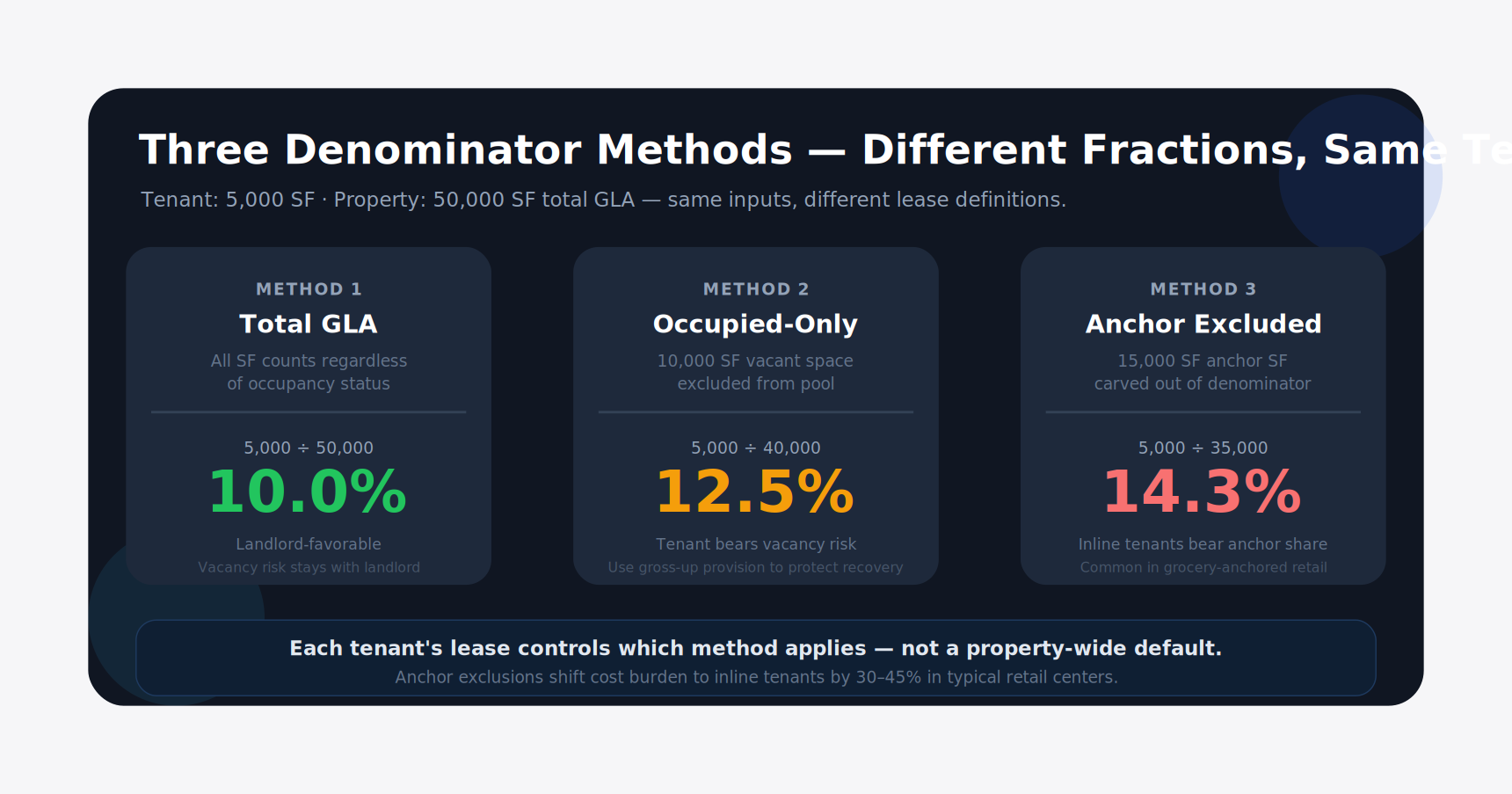
Where Landlords Most Often Go Wrong
The biggest mistakes are not in equations. They are in assumptions.
- Applying one denominator to all expense classes when leases define some classes as separate pools.
- Changing method after year-end close without a written addendum.
- Treating partial year occupancy as full-year area without prorating denominator.
- Using lease-approved area in one file and approved CAM estimate area in another.
You do not need to build perfect math if you do not maintain perfect consistency and visibility.
Three Questions to Set Before Every CAM Cycle
Before you finalize a mixed-use pro-rata model, answer these:
1. Can the method be read directly from the lease abstract? If a new property manager cannot find it in the abstract in one minute, your method is not operationally safe.
2. Does every expense class use the same denominator rule? If not, document each exception clearly. Property tax, insurance, and shared security may need different denominator logic.
3. What is the change policy for the current year? If denominator inputs change due to space conversions or vacancies, set approval thresholds and a date for applying those changes.
A Practical Mixed-Use Example
A tenant in the ground-floor retail suite occupies 2,500 square feet and shares HVAC, water, and alarm costs.
If total building rentable area is 50,000 square feet:
- At 5% share, recoverable share = $20,000 x 5% = $1,000.
But if only 35,000 square feet is in recoverable CAM zones and the tenant's suite is in those zones:
- At 7.14% share, recoverable share = $20,000 x 7.14% = $1,428.
The difference is not academic. It is what tenants ask you to explain on invoice day.
Do not choose a cleaner number. Choose the method that matches the lease abstraction and the cost pool each expense belongs to.
How to Keep This Stable in Practice
For mixed-use owners, the simplest governance framework is:
- Define denominator by expense class in the lease model.
- Lock the selected denominator in the abstract and internal source of truth.
- Recalculate only after documented occupancy and ownership changes.
- Archive denominator date ranges and calculation snapshots with each CAM package.
The point is not to avoid variance. It is to make any variance traceable.
PigJet is built to keep lease data, occupancy context, expense class definitions, and CAM outputs tied together so your team can see where a denominator came from when review questions arrive.
Final Checklist Before CAM Distribution
1. Confirm denominator method in each cost pool. 2. Confirm method is documented in the lease abstract and CAM policy. 3. Confirm occupancy and leased-area snapshots match the same date window as expenses. 4. Confirm method was not changed mid-cycle without written approval. 5. Confirm tenants understand the method before final estimates are sent.
If the method is clear, most CAM objections become timing and documentation issues, not denominator disagreements.