NNN Operating Expense Caps and CAM Exclusions: What Every Landlord Needs to Know
When you sign a NNN lease with controllable expense caps and a list of excluded CAM categories, you're agreeing to run two separate reconciliation calculations at year-end — not one. That's the part most landlords don't plan for until December arrives and they're staring at an expense report they can't reconcile cleanly.
Here's how caps and exclusions work in practice, where the mistakes happen, and what it takes to track them correctly across a multi-tenant portfolio.
---
Why Your CAM Pool Splits in Two
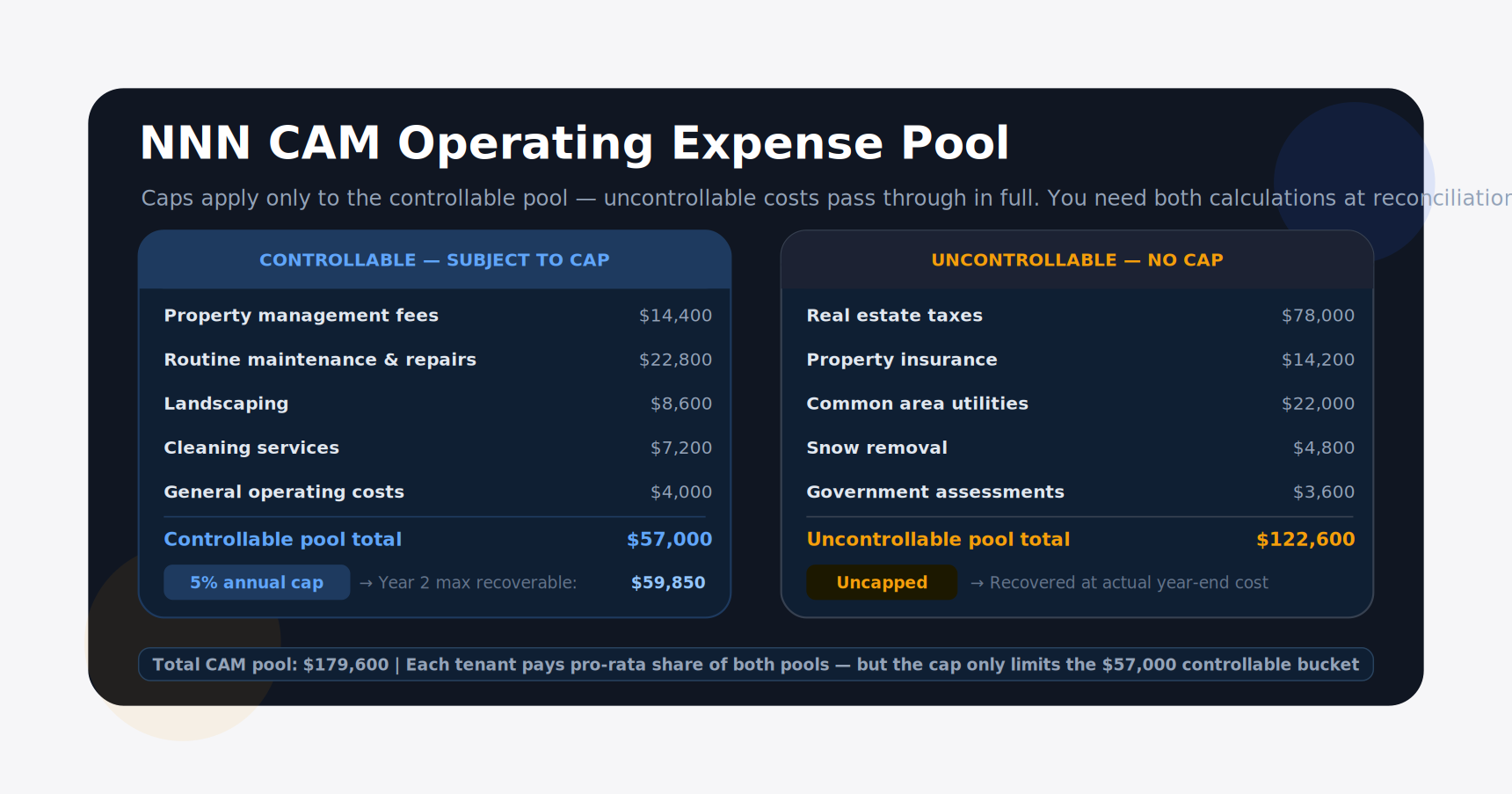
Most NNN landlords understand the concept of a cap. What fewer anticipate is what it requires at reconciliation: separating every operating expense into the controllable pool (subject to cap) and the uncontrollable pool (not subject to cap) before any calculations begin.
Controllable expenses are costs the landlord can influence: management fees, maintenance contracts, landscaping, cleaning services, general repairs. Uncontrollable expenses are outside the landlord's control: property taxes, insurance premiums, common area utilities, and in most leases, snow removal.
Caps apply only to the controllable bucket. If property taxes increase 15% this year, that passes through in full — no cap limits it. Only the expenses your management decisions can affect are subject to the ceiling.
The result: every CAM reconciliation on a capped lease requires two parallel calculations that stay separate through the entire process.
---
The Three Cap Structures You'll See
Annual prior-year cap: Controllable expenses can increase no more than X% over what was billed the prior year. The most common structure. A 5% prior-year cap on a $57,000 controllable pool limits year-two recovery to $59,850 — regardless of what you actually spent.
Base-year cap: Controllable expenses are measured against a fixed base year, typically year one of the lease. Each year compares to that starting point, not to the prior year. If controllable expenses have grown significantly since year one, the base-year cap can allow more recovery than a prior-year cap would.
Cumulative cap: Increases compound. A 5% cumulative cap in year five has stacked to allow a larger controllable pool than a prior-year cap would produce over the same period. Unused capacity in low-growth years rolls into future years.
The formula matters significantly at year-end. Applying the wrong cap structure either overbills the tenant — a breach of lease — or leaves recoverable income on the table. In a prior-year cap lease, the base shifts every year and must be accurately maintained. In a base-year lease, you need the original year-one number held precisely through the life of the lease.
---
What Exclusions Remove From the Pool
Before caps are applied, exclusions come out first. Common exclusion categories and their reconciliation impact:
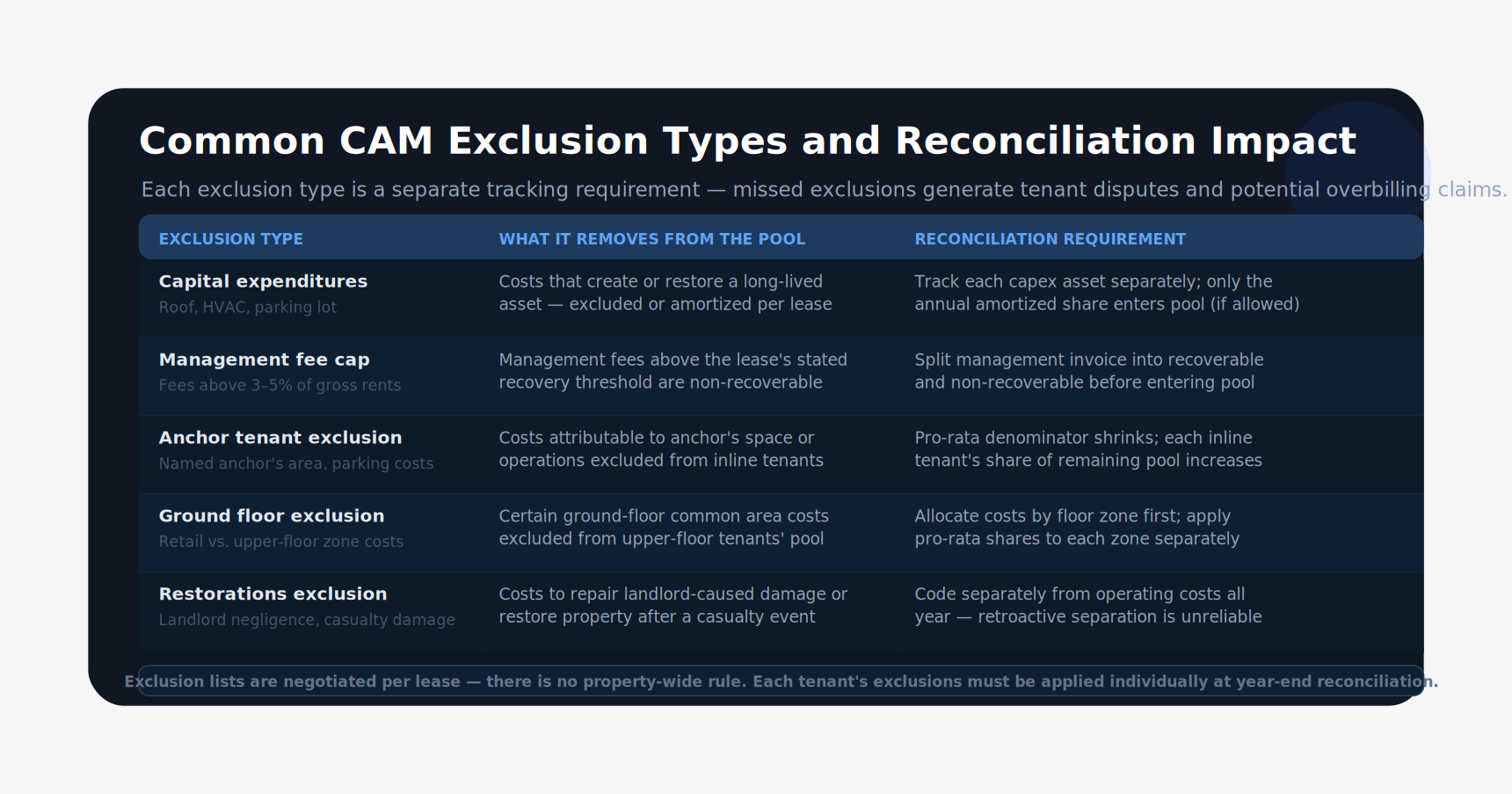
Capital expenditures: A full HVAC replacement, a new roof, parking lot resurfacing — these create or restore long-lived assets and are excluded from CAM in most leases. Some leases allow amortized recovery: the capital cost is spread over the asset's useful life and only the annual amortized share enters the pool. If your lease allows this, each capital asset needs its own amortization schedule maintained separately from operating expenses.
Management fee caps: Many leases exclude management fees above a stated percentage — typically 3% to 5% of gross rents. If your management contract runs at 8%, the excess above the lease threshold is non-recoverable. The management invoice has to be split between billable and non-billable portions before it enters the pool.
Anchor exclusions: In multi-tenant retail properties, costs attributable to an anchor tenant's space or operations are often excluded from inline tenants' CAM pools. The practical effect: the pro-rata denominator shrinks for the inline pool, which means each inline tenant's share of the remaining expenses increases.
Restorations: Costs to fix damage caused by the landlord's own negligence, or to restore the property following a casualty event, are typically excluded. These need to be coded separately from normal operating expenses throughout the year — not identified retroactively at reconciliation time.
---
How Caps and Exclusions Compound Across Tenants
A single tenant with a cap and an exclusion list is manageable. Three tenants with different cap structures, different base years, different exclusion lists, and different management fee thresholds running across multiple lease years is where the process starts to break.
Consider: Tenant A has a 5% prior-year cap and excludes management fees above 4%. Tenant B has a base-year cap from 2022 and allows HVAC amortization. Tenant C has a cumulative cap and an anchor exclusion that reduces their pro-rata denominator. That's three separate controllable pool calculations, two different cap formulas, a management invoice split, and an adjusted pro-rata share — all before the uncontrollable pool, which is calculated separately for each tenant.
Every year, each controllable pool number becomes the starting point for the following year's cap calculation. Errors compound. A misclassified capital expense in year two that ended up in the controllable pool inflates the year-three cap ceiling, which inflates year-four's, and so on. By the time an error surfaces in a tenant audit, it may cover three or four years of overcollection.
---
Where Landlords Get It Wrong
Applying the cap to the combined expense pool. The most common mistake. Caps apply to the controllable portion only. Applying them to the total pool underbills tenants if uncontrollable expenses ran high, or overbills them if controllable costs are being capped at a rate that doesn't match the lease formula.
Using a prior-year controllable total that was itself miscalculated. If year one was wrong, every subsequent cap ceiling is wrong. The error carries forward indefinitely.
Putting capital costs in the operating pool. An HVAC compressor replacement is maintenance. A full unit replacement is a capital expense. If your lease excludes capital expenditures and you've been including full replacements in the CAM pool, you have overbilling exposure across multiple years — exactly the kind tenants' auditors find.
For more detail on how this plays out specifically with HVAC, this breakdown of capital versus CAM treatment in NNN leases covers the line that matters most.
---
How PigJet Tracks This
I built PigJet because managing controllable and uncontrollable pools across a multi-tenant portfolio in spreadsheets was breaking the reconciliation every year-end. Cap calculations were manual, exclusion logic was buried in lease files, and amortization schedules for capital items were in separate documents no one maintained consistently. One person leaving the team meant the entire methodology left with them.
PigJet models the two-pool structure at the lease level. Controllable and uncontrollable expenses stay separated from the start. Cap formulas are stored per lease and applied automatically at reconciliation. Exclusion categories are defined once per lease and carried through every year's calculation. Capital amortization schedules run separately from the operating pool and only enter CAM for the tenants whose leases permit recovery.
---
Get the Calculation Right at Year-End
If you're managing CAM reconciliations with caps and exclusion provisions across multiple tenants, the margin for manual error is significant — and the audit exposure can run years back.
Visit pigjet.com to see how PigJet handles controllable versus uncontrollable expense tracking, cap calculations, and CAM exclusions for a portfolio your size.