NNN Lease Gross-Up Provisions: How Occupancy Affects Your CAM Pool

NNN lease gross-up provisions are one of the more technically specific clauses in commercial leases — the kind most landlords agree to without fully understanding how they'll play out during a partial vacancy. Here's how they work, when they matter, and what you need to track to apply them correctly at CAM reconciliation.
What Is a Gross-Up Provision in an NNN Lease
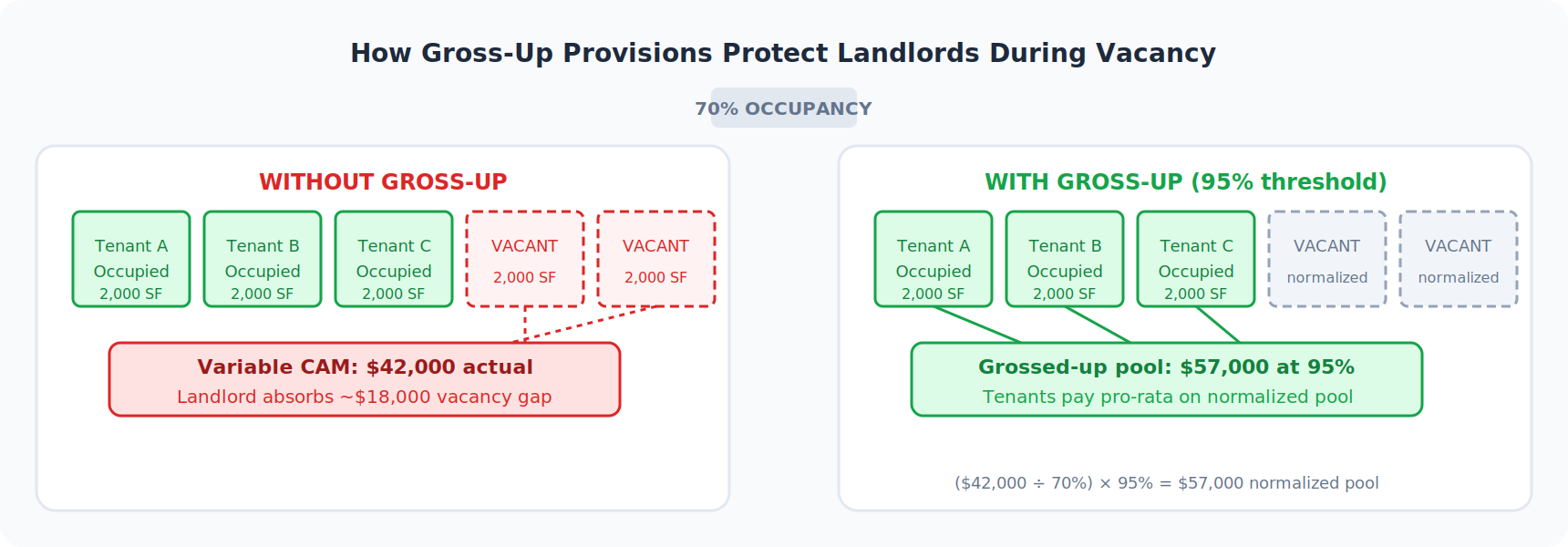
A gross-up provision lets the landlord normalize variable operating expenses to a higher occupancy level when the building is only partially occupied. Without it, vacancy exposes the landlord to a cost absorption problem: expenses like common area cleaning, lighting, HVAC maintenance, and parking lot upkeep don't scale down proportionally when suites go dark. A five-unit strip with two vacancies still has a parking lot that needs sweeping.
Without gross-up, those unrecovered variable expenses land on the landlord. With gross-up, they're adjusted to what those costs would have been at, say, 95% occupancy — and the occupied tenants pay their pro-rata share of the normalized pool. No one pays more than 100% of normalized costs; the landlord simply isn't absorbing the vacancy gap out of pocket.
The Math Behind Gross-Up Calculations
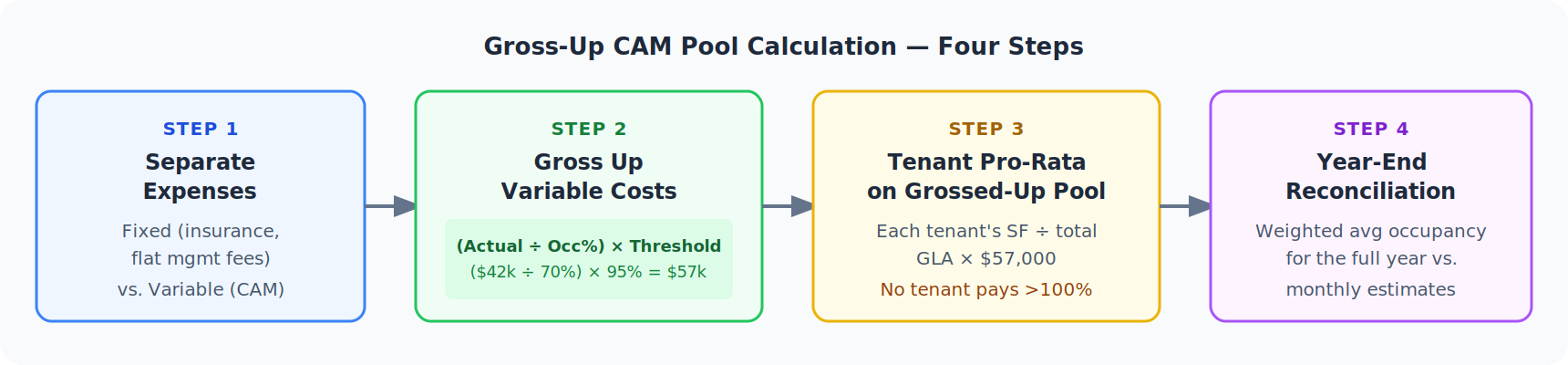
The calculation runs in four steps.
Step 1: Separate fixed from variable expenses. Fixed expenses — a flat-rate insurance premium, for example — don't vary with occupancy, so they're excluded from gross-up. Variable expenses — janitorial, landscaping, utilities for common areas, parking lot maintenance — are the gross-up eligible pool.
Step 2: Normalize variable expenses to the gross-up threshold. If the lease specifies a 95% gross-up and the building is running at 70% occupancy, the formula is:
Grossed-up expense = (Actual variable expense ÷ Actual occupancy %) × Gross-up threshold %
At $42,000 in actual variable expenses: ($42,000 ÷ 0.70) × 0.95 = $57,000
Step 3: Calculate tenant pro-rata share against the normalized pool. Each tenant's share is applied to the $57,000 grossed-up figure, not the $42,000 actual. The tenant pays more than they would without gross-up — but the landlord cannot collect more than 100% of the normalized pool from all occupied tenants combined.
Step 4: Reconcile at year-end. Annual CAM reconciliation uses weighted average occupancy for the year, actual variable expenses by month, and the gross-up threshold in each lease. If occupancy improved during the year, the gross-up adjustment shrinks. If it declined, it grows.
---
---
What Your Lease Actually Needs to Say
Gross-up language varies considerably in quality. When reviewing NNN leases — or negotiating new ones — look for four things:
A specific occupancy threshold. Most leases say 90% or 95%. Vague language like "deemed fully occupied" without a percentage creates dispute risk at reconciliation. If the threshold isn't defined, the landlord and tenant will have different assumptions about what number goes into the denominator.
A defined list of variable expenses. Better leases enumerate which expense categories are gross-up eligible. Leases that say "all expenses shall be grossed up" are overbroad — property taxes and flat insurance premiums aren't variable in the relevant way, and tenants will push back on gross-up treatment for them. The cleaner approach is explicit: janitorial, parking lot maintenance, landscaping, and common area utilities are in; property taxes, management fees, and insurance are out.
The calculation method. Per-square-foot normalization or percentage-of-actual are both used. They produce different results and the method should be specified in the lease, not left to inference or negotiation at year-end.
Why Landlords Struggle at CAM Reconciliation
Annual CAM reconciliation is where gross-up provisions either run cleanly or create disputes. During the year, tenants pay monthly CAM estimates based on a projected gross-up. At year-end, you reconcile actual expenses against the grossed-up pool used for estimates.
The inputs you need to do this accurately:
- Actual occupancy by month (to calculate a weighted average for the year)
- Actual variable expenses separated from fixed, month by month
- The gross-up threshold per lease — different tenants in the same building may have different thresholds if their leases were negotiated at different times
- Each tenant's pro-rata share denominator (occupied GLA or total GLA, depending on the lease)
Landlords running CAM reconciliation from spreadsheets often struggle with the occupancy tracking piece. If occupancy moved during the year, the weighted average calculation requires month-by-month records — a single year-end snapshot isn't enough.
The Landlord Trap: When Your Lease Has No Gross-Up
If your lease is silent on gross-up, vacancy exposure falls entirely to you. A landlord with a five-unit strip where two suites go dark absorbs 100% of variable CAM from property cash flow — not from the three occupied tenants.
Older leases often don't address gross-up at all. Acquisition due diligence should check for gross-up language in every lease. If a tenant's existing lease lacks it, the renewal negotiation is the moment to add it.
How PigJet Tracks Gross-Up
PigJet's CAM reconciliation workflow tracks occupancy by lease period, categorizes expenses by type, and applies gross-up adjustments per the terms in each lease. When occupancy changes — a new tenant signs, a dark suite comes back online — the gross-up calculation updates for that period.
At year-end reconciliation, PigJet surfaces the gross-up adjustment line alongside actual expenses and tenant estimates. Tenants who question a gross-up charge can see the calculation directly — which closes disputes faster than explaining variable expense normalization from a spreadsheet printout.
For landlords managing multiple properties, maintaining the gross-up calculation per lease matters. Tenants in the same building may have negotiated different thresholds — applying a single property-level assumption will be wrong for at least one of them and won't hold up to a CAM audit.
---
Most NNN landlords know vacancies affect cash flow. Fewer track the operational detail that vacancy also affects CAM cost recovery unless gross-up provisions are working correctly. The lease language sets the rule; the occupancy tracking makes it enforceable; the year-end reconciliation math closes the loop.
For landlords reviewing portfolio leases, the gross-up provision — its occupancy threshold and eligible expense scope — is worth auditing before the next vacancy event makes it matter.