Security Deposit Management in NNN Commercial Leases: What Landlords Need to Track

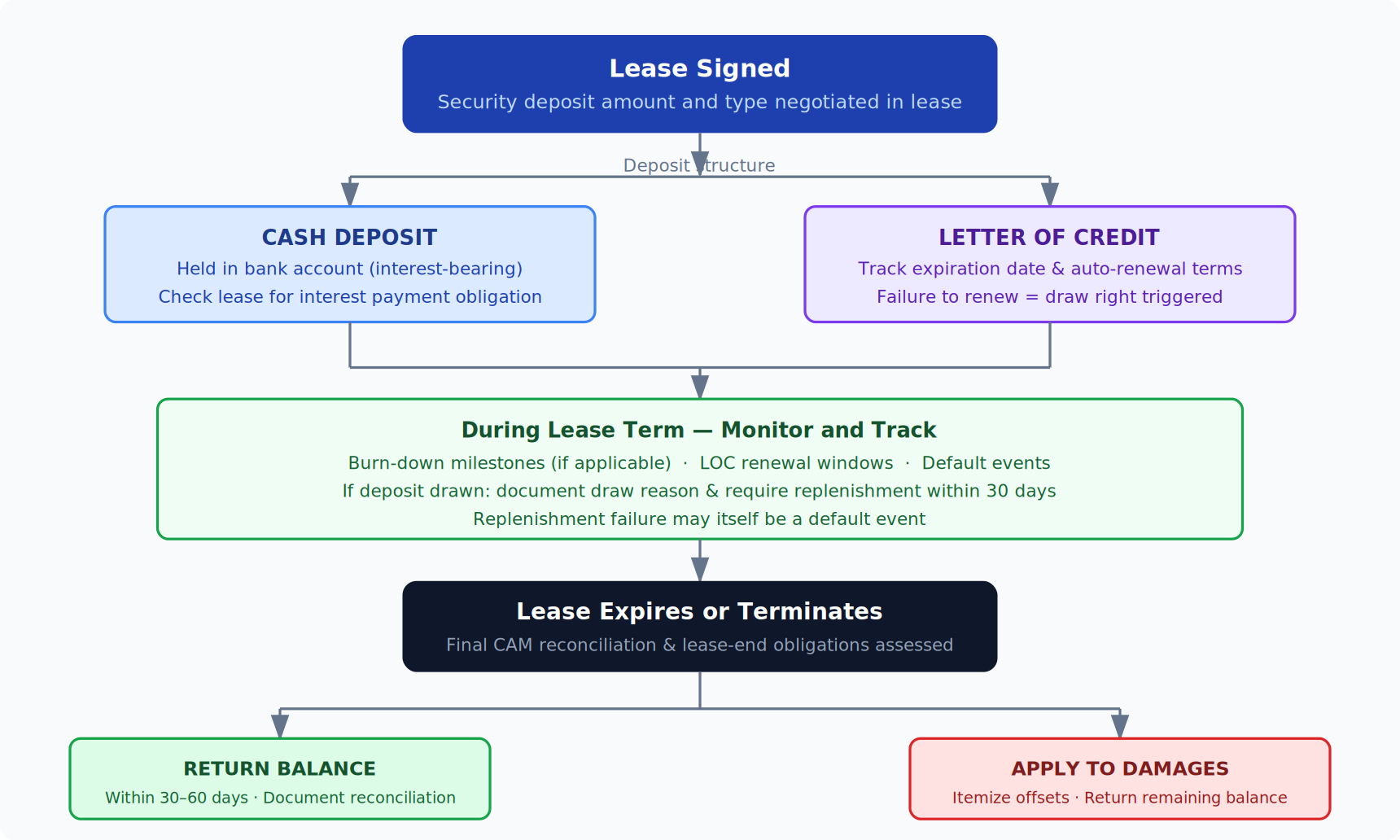
Security deposits in NNN commercial leases are not like residential deposits. The amounts are larger, the legal framework is more permissive, and the consequences of mishandling them — at the start of a lease or at the end — can be expensive. If you manage NNN retail properties, here is what you need to understand about how these deposits work and what you should be tracking throughout the lease term.
---
How Deposit Amounts Are Set
There is no two-months-rent default in commercial leasing. Amounts are negotiated, and the range is wide.
For a new tenant with limited operating history, three to six months of base rent is not unusual. For a credit tenant — a national chain or a franchisee backed by a corporate guarantee — landlords sometimes accept one to two months or waive cash entirely in favor of a letter of credit. The amount reflects your read of tenant risk; there is no statutory formula to fall back on.
Burn-down provisions are common in situations where the deposit starts high but the tenant earns reductions over time. A typical structure: the deposit drops from four months to two months after 24 consecutive months of on-time payments with no lease defaults. If the tenant earns the reduction, they get their money back in stages. If they default before earning it, the full original amount stays with you. These milestones need to be tracked — they are easy to miss when a lease is several years in.
---
The Letter of Credit Problem Most Landlords Underestimate
Many commercial tenants — especially larger ones — prefer to post a letter of credit rather than cash. From your perspective, the difference matters.
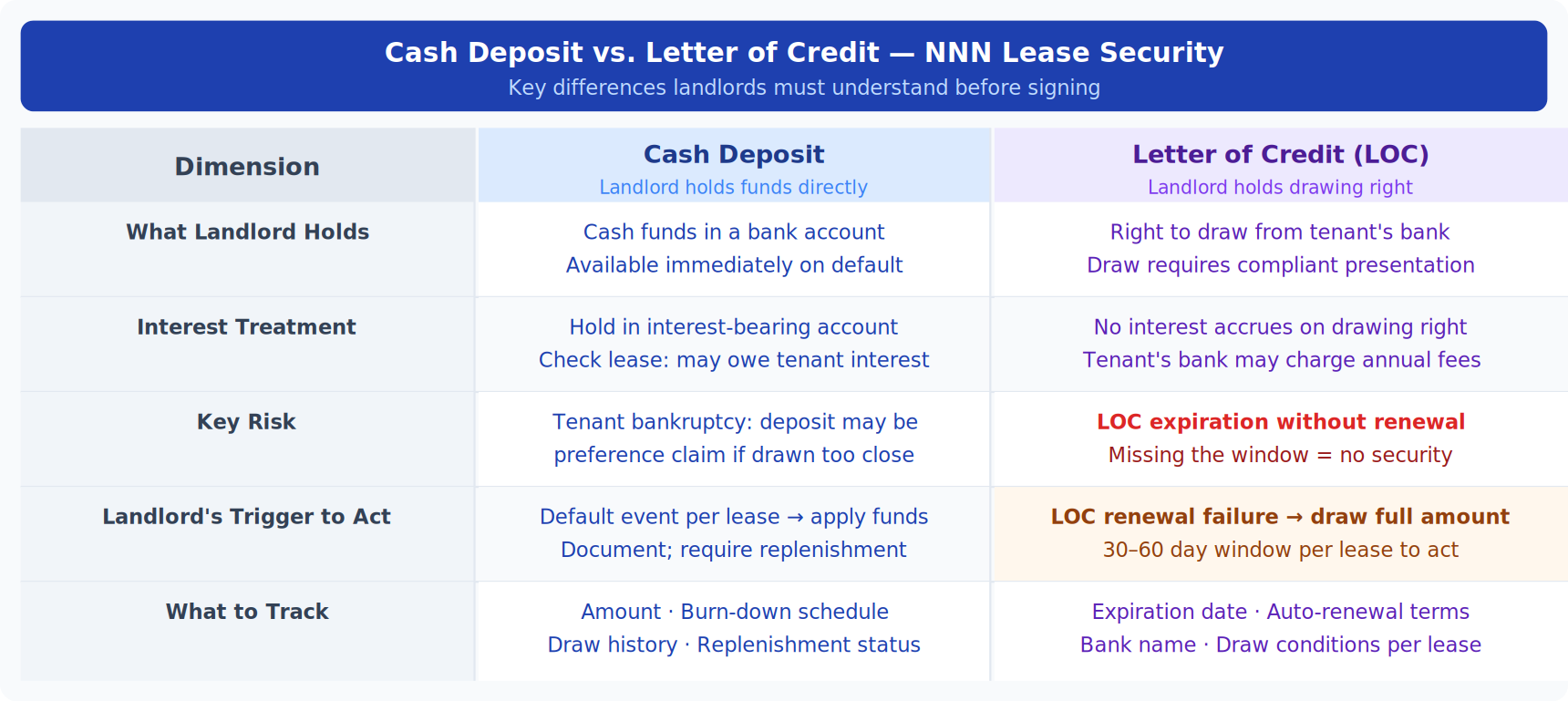
With a cash deposit, you hold funds. With a letter of credit (LOC), you hold a right to draw funds from the tenant's bank under defined conditions. The practical implication: you do not hold anything tangible until you present a compliant draw demand. And letters of credit expire.
Typical LOCs auto-renew annually, which works fine until it does not. If a bank changes its auto-renewal terms, if the tenant fails to instruct the renewal, or if the LOC simply lapses without notice — you now hold nothing. Most commercial leases create a draw right triggered by the tenant's failure to renew the LOC within 30 to 60 days before expiration: you can draw the full amount as a remedy. But that clause only protects you if you are paying attention to the calendar.
Missing the LOC renewal window is one of the most common security deposit failures in NNN portfolios. The lease language is usually right. The tracking system is not.
---
Interest on Commercial Security Deposits
This is where commercial leasing diverges from residential: most states have no requirement to pay interest on commercial security deposits. The statutory rules that apply to residential landlords — segregated accounts, set interest rates, annual statements — generally do not extend to commercial contexts.
There are exceptions. Some states impose interest requirements on commercial deposits above certain thresholds or lease durations. More importantly, your lease may create its own obligation regardless of state law. Tenants negotiating on large upfront deposits sometimes push for interest at a benchmark rate — one-year Treasury, SOFR plus a spread, or a fixed percentage. If the lease says you owe it, you owe it.
For practical purposes: hold cash deposits in an interest-bearing account regardless of whether you must pay interest to the tenant. The spread between what the account earns and what the lease requires you to pay — if anything — is yours. More importantly, it keeps the funds identifiable and documented for return or application purposes.
---
When and How to Apply the Deposit
Your lease should define the events that allow you to apply the deposit. Common triggers:
- Failure to pay base rent or NNN expenses after the notice and cure period has run
- Abandonment of the premises
- Bankruptcy filing by the tenant
- Material breach not cured within the permitted timeframe
Applying the deposit does not extinguish the underlying obligation. When you draw on a deposit, you are reducing your damages — the tenant still owes the full rent debt. Document the draw: send written notice to the tenant specifying the triggering event, the amount applied, and the balance remaining. Keep that notice in the lease file.
Most leases require tenants to replenish the deposit within 30 days of any draw. Track replenishment separately. If the tenant does not restore the deposit as required, the failure to replenish is often itself an event of default — one that compounds the original breach.
---
Return Timelines and Documentation at Lease End
Commercial leases typically give landlords 30 to 60 days after lease expiration to return the deposit. Because NNN leases involve CAM reconciliation that may not close until months after year-end, some landlords negotiate a two-stage return: a portion on the expiration date, the balance after final CAM settlement.
When you return — or partially apply — the deposit, document everything:
- Original deposit amount and the date it was received
- Any burn-down reductions that occurred and when
- Any draws made during the lease term and the events that triggered them
- The final reconciliation showing exactly how the return amount was calculated
You will need those records if the tenant disputes the return amount or if you are applying any portion toward lease-end obligations like unpaid CAM true-ups, unreturned keys, or restoration requirements.
---
---
Tracking Deposits Across a Portfolio
One property with one deposit is manageable with a spreadsheet. Five properties with a mix of cash deposits, letters of credit on different bank forms, burn-down schedules at different stages, and LOC expiration dates scattered across the calendar is not.
When I was building PigJet for my own NNN retail portfolio, security deposit tracking was one of the first things I modeled — not because it is exciting, but because a missed LOC renewal window or a forgotten burn-down milestone has real financial consequences with no warning. You find out when it is too late.
PigJet tracks deposit type, amount, applicable burn-down schedules, LOC expiration dates, and renewal deadlines per lease. LOC expiration windows surface before the draw deadline closes. Burn-down milestones are calendar events that show up in your lease dashboard, not footnotes buried in a file.
If you are managing more than a few commercial leases, security deposit tracking is worth building into your system — before something expires unnoticed.
Visit pigjet.com to see how PigJet handles lease-level deposit tracking, LOC expiration alerts, and burn-down milestone management across your NNN portfolio.