Commercial Lease Option Tracking: Renewal, Expansion, and Termination Dates Landlords Miss

Commercial lease option tracking is one of those landlord workflows that looks simple until a deadline is missed. A renewal option sits in the lease. A termination right has a notice window. A tenant has an expansion right that only matters if a neighboring suite becomes available. A purchase option has a trigger date that nobody remembers until the tenant asks about it.
For a landlord with one property and two tenants, a calendar reminder may be enough. For a commercial portfolio with several NNN leases, staggered amendments, and different option language by tenant, option tracking becomes a real operating risk.
The problem is not just remembering dates. The problem is understanding what the date means, who has the right, what notice is required, what rent changes if the option is exercised, and what happens if the window is missed.
What Counts as a Commercial Lease Option?
A commercial lease option is any contractual right that lets one party make a future decision under defined terms. In landlord operations, the most common options include:
- Renewal options
- Extension options
- Early termination options
- Expansion rights
- Contraction rights
- Purchase options
- Rights of first refusal
- Rights of first offer
- Exclusive use rights with operational triggers
Some options are obvious because they have the word option in the heading. Others are buried in assignment language, relocation provisions, co-tenancy clauses, or amendments. That is why commercial lease option tracking should start with a full lease abstract, not a quick scan of the business terms.
If the lease has been amended, the original option language may not be the final answer. A renewal option may have been replaced, waived, extended, or conditioned on tenant compliance. The tracking system has to reflect the active agreement, not just the original lease.
Why Renewal Options Cause So Many Problems
Renewal options are the most familiar lease option, and they are also one of the easiest to mishandle.
A typical renewal option might say the tenant can extend the term for one additional five-year period by giving written notice no earlier than 12 months and no later than 6 months before expiration. That creates at least three dates a landlord needs to track:
- The lease expiration date
- The first day the tenant can give notice
- The last day the tenant can give notice
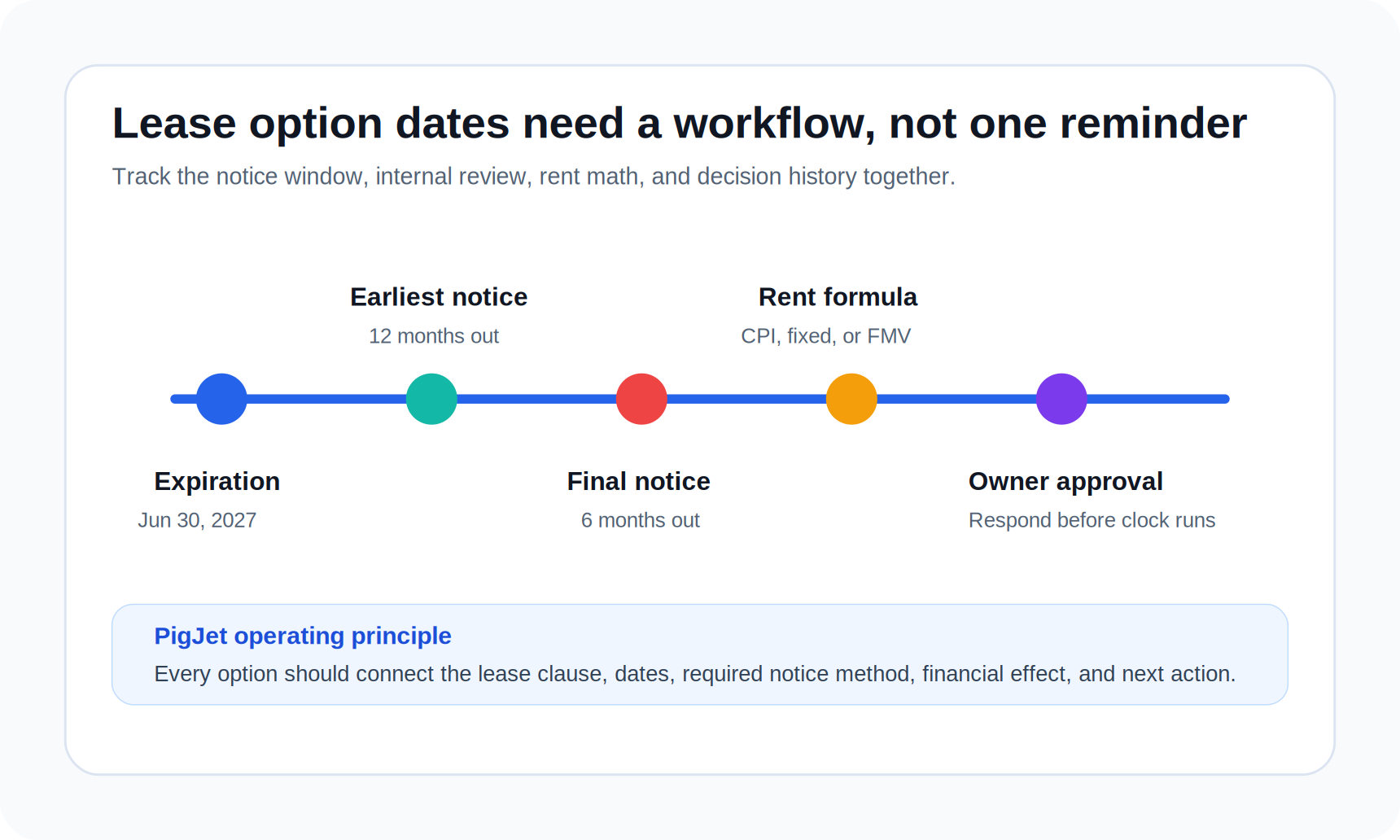
The rent during the renewal term may be fixed, tied to CPI, based on fair market rent, or determined through an appraisal process. That means the option is not just a legal date. It is a financial event.
For NNN landlords, renewal options also affect CAM estimates, insurance recoveries, tax pass-throughs, lender reporting, and future leasing plans. If the tenant renews, the landlord needs updated billing schedules. If the tenant does not renew, the landlord needs enough lead time to market the space and plan for vacancy.
Notice Windows Matter More Than Expiration Dates
Many landlords track expiration dates but miss notice windows. That is the wrong priority.
The expiration date tells you when the lease ends. The notice window tells you when action has to happen. If a tenant has to exercise a renewal option by December 31 and nobody flags it until January 15, the useful deadline has already passed.
A clean lease option tracking process should include:
- Earliest notice date
- Final notice date
- Required notice method
- Required recipient
- Whether notice must be delivered, mailed, emailed, or received
- Whether the tenant must be in good standing
- Any rent calculation triggered by exercise
- Internal owner approval needed before responding
That last point matters. Some leases require a landlord response after notice is received. Others create negotiation deadlines around fair market rent. If the landlord team is waiting for legal review, lender approval, or ownership input, the internal deadline should be earlier than the contractual deadline.
Expansion and Contraction Rights Need Operational Context
Expansion rights are harder to track than renewals because they often depend on facts outside the tenant's lease. A tenant may have the right to expand into adjacent space when it becomes available. Another tenant may have a right of first offer on the same space. A landlord may have to notify one tenant before marketing the suite to the broader market.
That means option tracking has to connect lease rights to the physical property.
For each expansion or contraction right, track:
- Which suite or space is affected
- Whether the right is exclusive or shared
- Whether the right is ongoing or only available once
- Whether it applies automatically or only after landlord notice
- Whether another tenant has a competing right
- How rent is determined if the right is exercised
Without that context, expansion rights get lost in a spreadsheet. The issue often surfaces only when a leasing broker starts marketing space and a tenant points to their option language.
Termination Options Are Financial Events
Early termination rights can change the economics of a property quickly. A tenant may have the right to terminate after year three with nine months notice and a termination fee equal to several months of rent. Another lease may let the landlord terminate if a redevelopment plan moves forward.
Those rights affect valuation, refinancing, leasing strategy, and tenant communication. They should not live only in a legal file.
When tracking termination options, include:
- Who can terminate
- When notice can be given
- When termination becomes effective
- Whether a fee is due
- Whether CAM, tax, and insurance charges survive through the termination date
- Whether the tenant must restore the premises
- Whether any guaranty obligations continue
For NNN leases, the pass-through piece is easy to overlook. If the tenant terminates mid-year, the landlord still needs to know how final recoveries, credits, and true-ups will be handled.
Purchase Options and ROFRs Need Extra Discipline
Purchase options, rights of first refusal, and rights of first offer carry higher stakes than ordinary lease deadlines. Missing one can affect a sale, financing, or ownership plan.
A right of first refusal may require the landlord to send a tenant a third-party offer before closing a sale. A right of first offer may require the landlord to approach the tenant before taking the property to market. A purchase option may let the tenant buy the property at a fixed price or formula during a narrow window.
These rights should be visible in any ownership, disposition, or refinancing workflow. They should also be flagged before a broker opinion of value, sale process, or lender package is prepared.
A lease option tracking system should make these rights hard to miss.
The Spreadsheet Problem
Many landlords start with a lease option spreadsheet. That is better than relying on memory, but spreadsheets usually break down for three reasons.
First, they separate dates from lease language. A cell may say renewal notice due 6/30/2026, but it rarely captures the exact notice method, rent formula, standing condition, or amendment history.
Second, spreadsheets are easy to update incorrectly. A lease amendment changes the expiration date, but the option deadline remains tied to the old date. A tenant exercises a renewal, but the next renewal option is not added. A property manager leaves, and nobody knows which tab is current.
Third, spreadsheets do not connect the option to the rest of property operations. A renewal option affects billing. A termination option affects CAM true-ups. An expansion right affects leasing. A purchase option affects ownership strategy. Those connections are hard to manage in a flat file.
A Better Commercial Lease Option Tracking Process
A practical option tracking workflow has five steps.
1. Abstract the Full Lease and Amendments
Start with the original lease, every amendment, every assignment, and every side letter. Do not assume the first lease abstract is current. If the tenant has been in place for years, the option language may have changed multiple times.
2. Separate Legal Dates from Internal Dates
For each option, track the actual contractual deadline and the internal review deadline. If notice is due by June 30, the landlord team may need a 90-day internal reminder to review rent, leasing plans, and ownership preferences.
3. Attach the Relevant Lease Language
Do not track a date without the clause behind it. The person receiving the reminder should be able to see the exact language, not just a summary.
4. Connect Options to Financial Workflows
If an option changes rent, billing, CAM estimates, or true-up timing, connect it to the financial workflow. A renewal option is not complete when the tenant sends notice. It is complete when the new rent schedule and recovery assumptions are reflected in operations.
5. Review Options Quarterly
Lease option tracking should not be a once-a-year cleanup project. A quarterly review gives landlords enough runway to handle upcoming renewals, market vacancies, plan capital work, and avoid surprise tenant notices.
What to Track for Every Lease Option
At minimum, every tracked option should include:
- Property
- Tenant
- Suite
- Lease document source
- Option type
- Party with the right
- Earliest notice date
- Final notice date
- Effective date
- Required notice method
- Rent or fee impact
- CAM or NNN impact
- Internal owner or legal review deadline
- Status: upcoming, open, exercised, waived, expired, or completed
- Link to the exact lease clause
That may feel like a lot of fields, but it is much cheaper than reconstructing the issue after a deadline is missed.
How PigJet Fits
PigJet is built around the commercial landlord workflows that sit between the lease and the accounting system: rent schedules, CAM recoveries, tenant obligations, and the deadlines that drive them.
For option tracking, the goal is simple: keep the clause, the date, and the operational consequence in one place. A renewal option should connect to the rent schedule. A termination option should flag final recovery work. An expansion right should be visible before a space is marketed.
That is the difference between storing a lease and actually operating from it.
Bottom Line
Commercial lease option tracking is not administrative busywork. It protects revenue, preserves landlord rights, supports tenant communication, and keeps NNN operations from turning into deadline management by memory.
If you manage more than a handful of commercial leases, the question is not whether your options are documented somewhere. The question is whether the right person will see the right clause before the useful deadline passes.