COI Tracking for NNN Landlords: The Tenant Insurance Compliance Problem Nobody Talks About
Why COI Tracking Is the Most Underestimated Task in NNN Property Management
Every NNN landlord knows the lease requires tenants to carry insurance. It's standard language in any commercial lease: general liability, property coverage, sometimes workers' comp, often an umbrella policy. The landlord gets named as an additional insured. Everybody signs and moves on.
Then a year passes. A tenant's policy renews. They forget to send the updated certificate. The landlord doesn't notice. Six months later, a slip-and-fall happens in front of the tenant's space. The policy was cancelled for non-payment three months earlier and no one caught it.
That scenario plays out at small CRE portfolios every year. Not because landlords are careless — because manual COI tracking is fundamentally unreliable at any meaningful scale.
---
What a Certificate of Insurance Actually Is
A Certificate of Insurance (COI) — most commonly issued on the ACORD 25 form — is a summary document from an insurance broker showing:
- The insured party (your tenant)
- Coverage types currently in effect
- Coverage limits for each policy line
- Policy effective and expiration dates
- Certificate holder (you, the landlord)
- Additional insured endorsement status
A COI is not the insurance policy itself. It's evidence that a policy exists. This distinction matters practically: a tenant can hand you a COI for a policy that's already been cancelled since the certificate was issued. The only reliable way to verify active coverage is to request confirmation directly from the insurer — or require that your tenant's broker send you advance notice of any cancellation.
The 30-day cancellation notice requirement is standard lease language. In practice, insurers don't always honor it reliably, which is why active tracking still matters even when your lease includes this provision.
---
What NNN Leases Typically Require
NNN lease insurance provisions vary by property type and tenant creditworthiness, but most well-drafted leases require tenants to maintain:
Commercial General Liability (CGL) Minimum limits of $1,000,000 per occurrence and $2,000,000 aggregate are standard for most retail and light industrial tenants. Restaurants, auto service, and medical tenants typically carry $2M/$4M or higher given elevated risk profiles.
Property Insurance Coverage on the tenant's personal property, trade fixtures, and leasehold improvements at replacement cost value. This covers the tenant's stuff — not your building.
Workers' Compensation Statutory limits per state, required if the tenant has employees. Frequently overlooked but important: if a tenant's employee is injured and there's no workers' comp in place, spillover liability claims can implicate the property owner.
Business Auto Required if the tenant operates vehicles in connection with their business.
Umbrella / Excess Liability Many landlords require a $3M to $5M umbrella on top of primary limits, especially for higher-risk tenants or properties with above-average foot traffic.
Landlord Named as Additional Insured Non-negotiable. The additional insured endorsement means your interests are protected by the tenant's policy. Without this endorsement — not just a checkbox on the certificate, but an actual endorsement on the underlying policy — the COI provides almost no meaningful protection.
Advance Notice of Cancellation Lease language commonly requires 30 days' notice if the policy is cancelled or not renewed. As noted, this provision is only as good as the insurer's compliance.
---
The Spreadsheet Trap
Here's how COI tracking works at a typical small NNN portfolio:
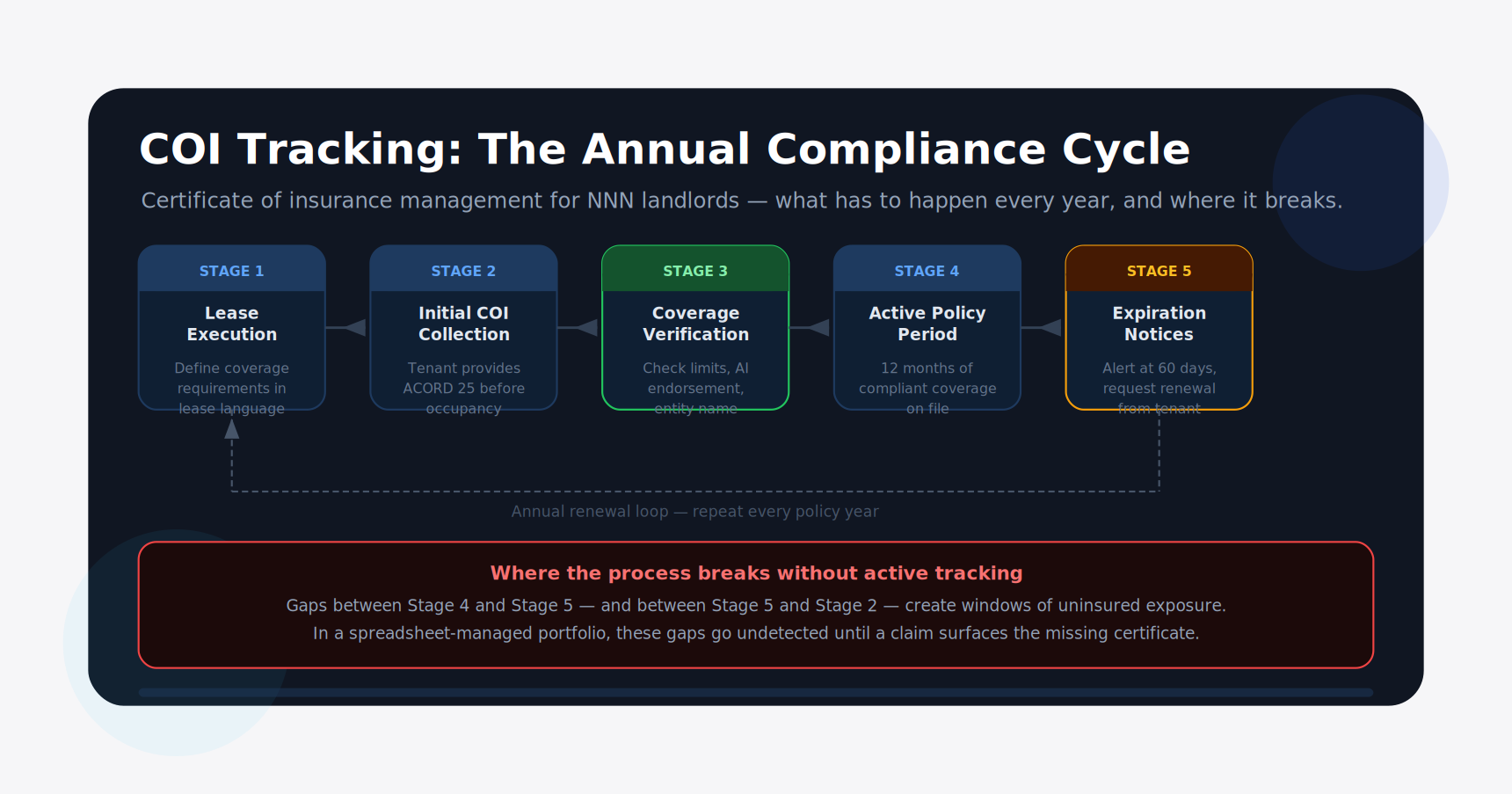
1. Collect COIs from all tenants at lease execution. 2. Store them somewhere — a Google Drive folder, an email thread, a filing cabinet. 3. Note expiration dates in a spreadsheet or calendar. 4. When an expiration approaches, manually email the tenant to request renewal. 5. Wait for the tenant to contact their broker and send a new certificate. 6. Receive the COI, check it manually, file it wherever the others live. 7. Repeat for every tenant, every year, on staggered schedules because everyone renewed at different times.
With five tenants, this is tedious but workable. With fifteen tenants across three properties, it's a recurring burden. With thirty-plus tenants, something always slips — not because of bad intentions, but because the system has no enforcement.
The fundamental problem: a spreadsheet doesn't proactively flag a COI that expires next month. It doesn't catch when a tenant sends a certificate naming the wrong entity as additional insured. It doesn't notice when coverage limits dropped below lease minimums at renewal. It depends entirely on someone actively checking it — and in a small portfolio operation, that check is the first thing to fall off when something more urgent comes up.
---
What Actually Goes Wrong
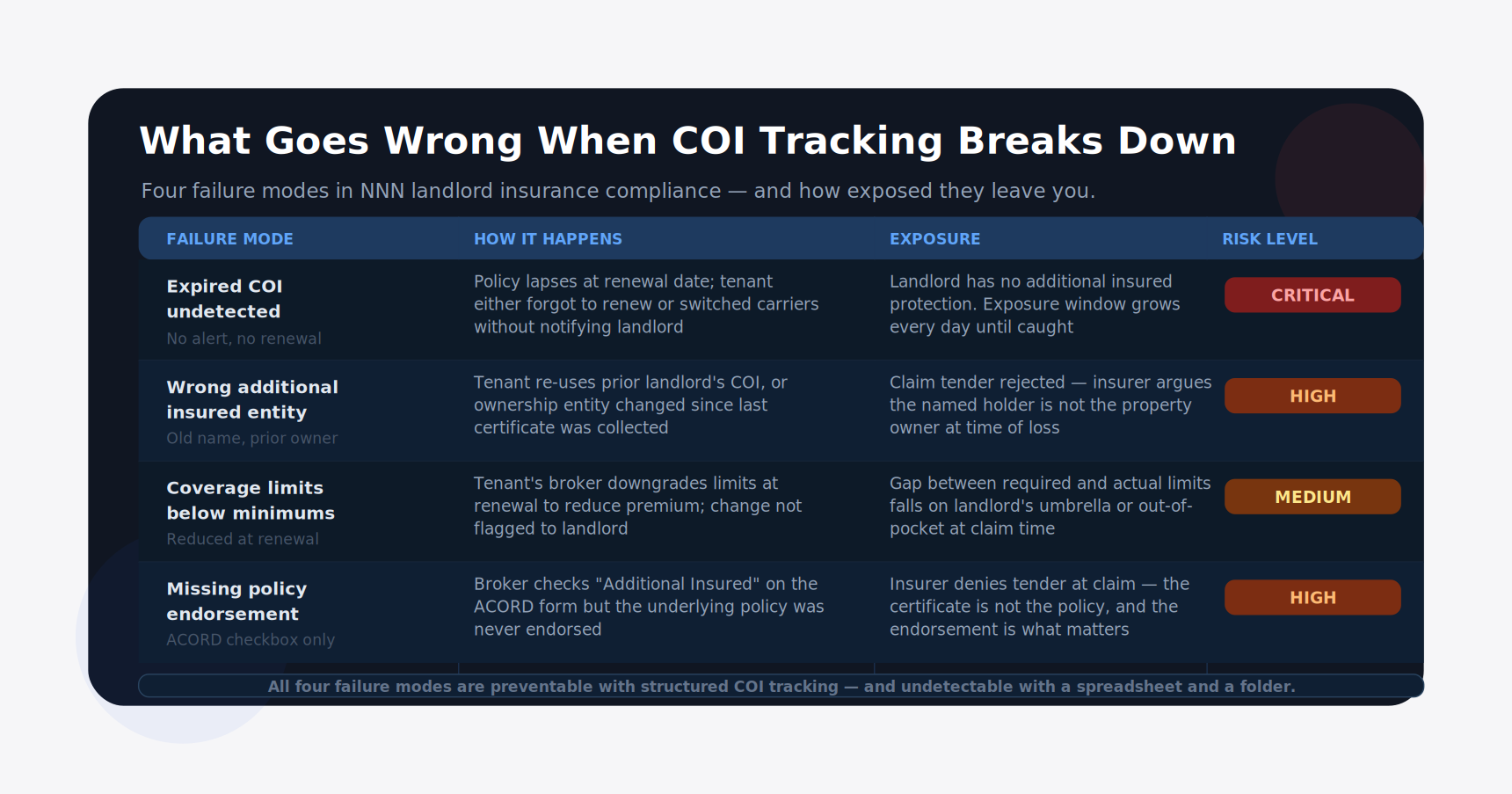
Expired COIs going undetected. A tenant renews their general liability but doesn't notify you. Their old certificate is in your file. You don't know their actual coverage status. If a claim arises, the certificate on file won't support an additional insured tender.
Wrong entity named as additional insured. Tenants sometimes provide certificates naming a prior landlord, a property manager, or the wrong LLC. If your ownership entity changed or you hold title through a different entity than the one on record, the COI becomes useless in a claim.
Coverage limits below lease minimums. A tenant required to carry $2M general liability renews at $1M — either because their broker downgraded without asking, or because they switched insurers and the new policy came in at different limits. You don't notice until an audit or a loss.
Missing endorsements. The additional insured status must come from an actual endorsement on the policy — not just a checkbox marked on the ACORD form. Some certificates show "additional insured" without the underlying endorsement existing on the policy. This gets challenged by the insurer when a claim is tendered.
Lapses during financial stress. Tenants who are financially stretched sometimes let policies lapse. This is exactly when you're most exposed as a landlord — and the least likely to have a compliant COI on file.
---
The Situations That Expose the Gap
Most landlords discover their COI tracking has failed in one of two ways.
At sale or refinancing. A lender requests current COIs for all tenants as part of due diligence. Three have expired. One names the wrong entity. One is missing entirely. The closing process stalls while you scramble to collect updated certificates from tenants, one of whom switched brokers and doesn't respond quickly. What should take a day takes two weeks.
After a claim. The tenant's insurer denies the additional insured tender because the certificate on file is outdated, the endorsement wasn't properly issued, or coverage has lapsed. You're now dealing with a liability exposure that the insurance requirement in your lease was supposed to prevent.
Both scenarios are entirely preventable with a system that actively enforces COI compliance — rather than passively files what comes in.
---
Building a COI Tracking System That Works
Regardless of what tools you use, effective COI management requires a few structural elements.
Centralized storage linked to the lease, not a file folder. A COI dropped into a folder named "Tenant X" is only marginally better than a COI buried in email search. What you need is the COI document linked directly to the lease record, with expiration dates surfaced in your property management view — not hidden in a folder hierarchy.
Proactive expiration tracking with advance notice. A functional system flags COIs 60 days before expiration and again at 30 days. By the time a certificate expires, you've already had two chances to request renewal. No surprises at closing.
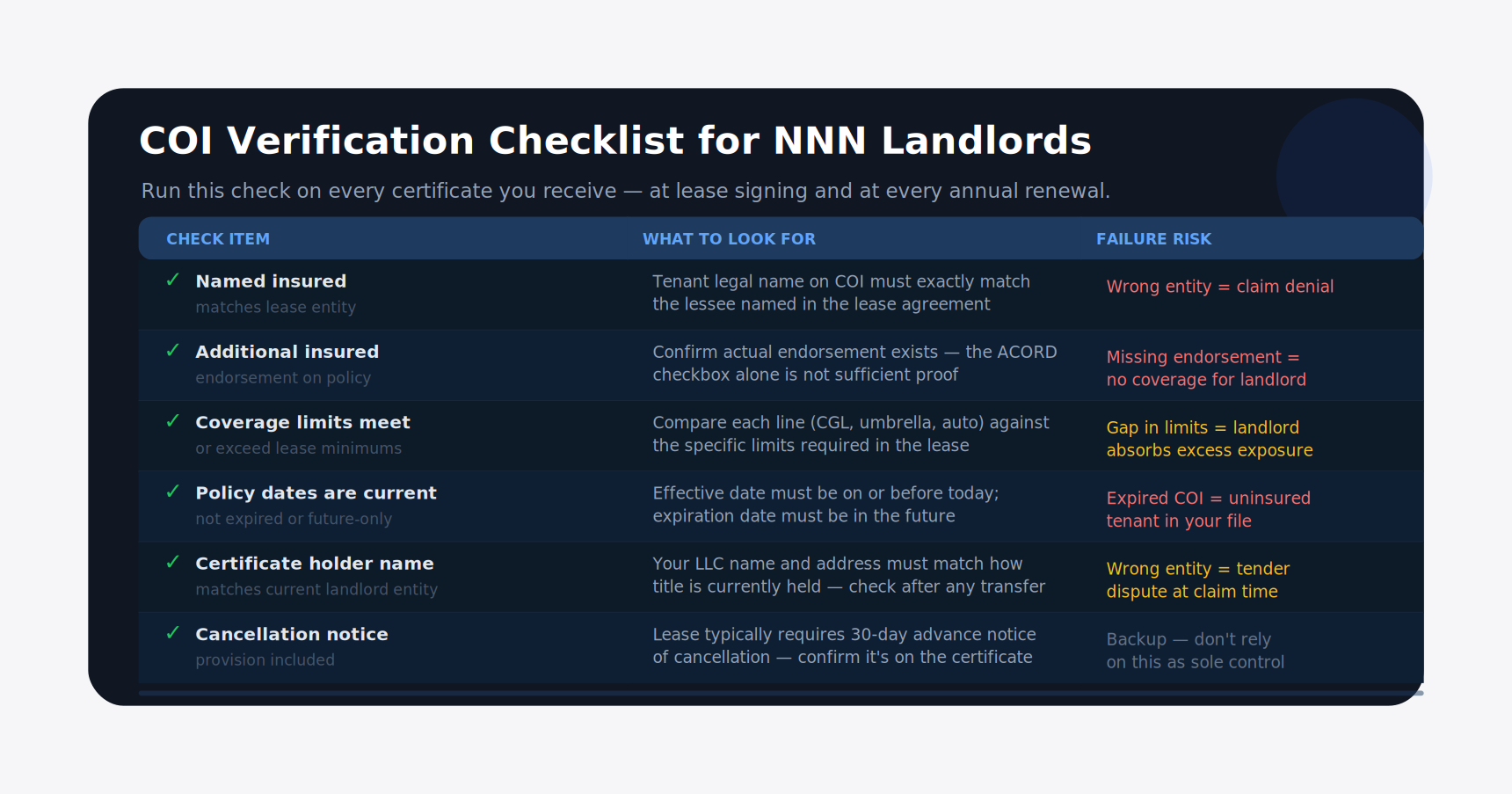
Structured verification checklist. When you receive a COI, there should be a defined checklist: Is the named insured correct? Does the additional insured endorsement actually exist on the policy (not just checked on the form)? Are limits at or above the lease minimums for each coverage type? Is the certificate holder name and address current? A structured check removes the "I think it looked okay" problem.
Automated requests instead of manual email hunts. The best systems generate COI request emails directly from the lease record, pre-populated with the tenant's required coverage amounts and your current entity details. The tenant forwards to their broker, the broker returns the certificate, and it lands in the right place.
---
How PigJet Approaches COI Tracking
PigJet ties certificate of insurance tracking directly to the lease record. Required coverage types and minimum limits are captured during lease abstraction — so when a COI comes in, the requirements to check against are already defined, not held in someone's memory.
Expiration reminders generate automatically based on the policy dates on the certificate. You don't need to maintain a parallel spreadsheet or calendar. The dashboard surfaces tenants with expired, expiring-soon, or missing COIs as a compliance task alongside your other lease administration work.
Because PigJet reads your QuickBooks data, it can also surface tenants who are late on rent payments — often the same tenants who let insurance lapse. Financial stress at the tenant level tends to appear across multiple signals at once. Seeing them together, rather than catching each one separately through different systems, changes how quickly you can respond.
> A COI filed and forgotten is not a compliance system. It's a paper trail that stops working the moment the policy behind it changes.
The administrative burden of COI management is real but finite. With a structured approach, the process runs on a predictable schedule rather than surfacing as a crisis at the worst possible moment. For NNN landlords using PigJet's lease management tools, COI tracking is one more thing that runs automatically — instead of through email, spreadsheets, and calendar reminders you rely on remembering to check.
---
For portfolios just getting organized on this, the first step is simple: collect current COIs from every active tenant, verify the additional insured endorsement exists (not just the checkbox), and note every expiration date in one place. From there, build forward with 60-day advance requests as standard practice. The overhead is low. The protection is real.