How NNN Landlords Should Respond When a Tenant Objects to CAM Charges
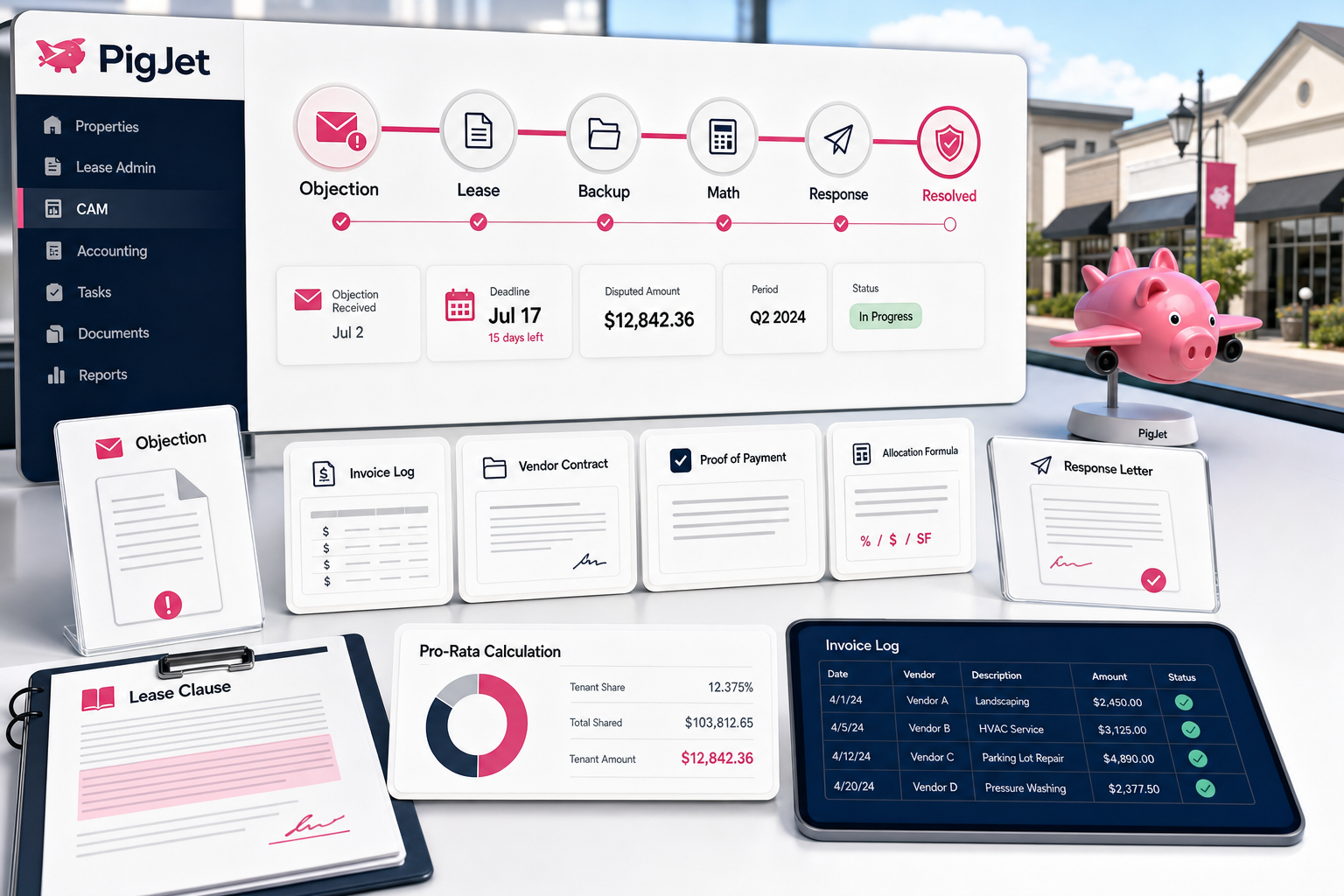

When a tenant disputes a CAM reconciliation, the first written response matters.
Not because one letter solves the dispute. It usually does not. The response matters because it sets the tone, defines the issue, preserves the paper trail, and keeps the conversation tied to the lease instead of drifting into a long email thread about whether the bill "feels high."
For NNN landlords, the goal is simple: acknowledge the objection, identify exactly what is being disputed, explain what documentation is available, and confirm the review process under the lease.
This article gives you a practical CAM dispute response letter template you can adapt for your property. It is not legal advice, and it is not a substitute for your lease or attorney. It is an operating template for keeping the response organized.
When To Use A CAM Dispute Response Letter
Use a formal response letter when the tenant has put a CAM objection in writing, requested backup, invoked audit rights, withheld payment, or challenged specific expense categories.
Do not rely on a casual email if the tenant's letter includes:
- a disputed dollar amount
- specific lease provisions
- a demand for invoices or vendor contracts
- a formal audit request
- a threat to withhold payment
- a deadline for landlord response
Those situations need a cleaner record. A response letter gives both sides one place to see what was received, what is being reviewed, what backup will be provided, and what the landlord's position is.
Before You Write, Separate The Objection From The Noise
Read the tenant's letter before drafting your response. You are looking for the actual dispute.
Some tenant letters are specific: "The 2025 CAM reconciliation includes parking lot resurfacing, which we believe is excluded under Section 7.4 because it is a capital improvement."
Others are vague: "We dispute the CAM reconciliation and request all backup."
Those two letters need different responses. The first requires a direct answer on the challenged line item and lease clause. The second may require a clarification request before you spend hours assembling every invoice in the file.
Create a short internal summary:
- date the tenant objection was received
- tenant name, suite, and lease
- reconciliation period
- amount billed
- amount disputed, if stated
- specific categories or clauses challenged
- whether payment was made on the undisputed amount
- audit deadline or response deadline under the lease
That summary becomes the spine of your response.
CAM Dispute Response Letter Template
Use the structure below as a starting point. Replace bracketed language with the facts from your lease, reconciliation, and documentation package.
---
`[Landlord / Property Manager Letterhead]`
`[Date]`
`[Tenant Name]`
`[Tenant Address / Suite]`
`Re: Response to CAM Reconciliation Objection - [Property Name], [Reconciliation Year]`
Dear `[Tenant Contact]`,
We acknowledge receipt of your `[date]` letter regarding the `[year]` CAM reconciliation for `[property / suite]`.
Based on your letter, we understand that you are disputing `[specific disputed item, category, amount, or "the reconciliation generally"]`. If our understanding is incomplete, please identify the specific line items, amounts, and lease provisions you believe are at issue so we can review them directly.
The reconciliation was prepared under the CAM, operating expense, and reimbursement provisions of the lease dated `[lease date]`, including `[section references]`. The reconciliation reflects actual recoverable expenses for the period `[start date]` through `[end date]`, less CAM estimates billed during the year.
We are reviewing the items identified in your letter and will provide the following support, as applicable under the lease:
- a summary of recoverable CAM expenses by category
- invoice or vendor backup for disputed or material items
- tax, insurance, or utility support where relevant
- the tenant pro-rata share calculation
- the actuals-versus-estimates calculation
- any applicable cap, exclusion, or adjustment schedule
At this time, our records show the following:
| Item | Amount | | --- | ---: | | Total recoverable CAM pool | `$[amount]` | | Tenant pro-rata share | `[percentage]%` | | Tenant share of actual CAM | `$[amount]` | | CAM estimates billed | `$[amount]` | | Balance due / credit | `$[amount]` | | Amount tenant has identified as disputed | `$[amount or "not specified"]` |
If you are invoking formal audit rights under the lease, please confirm the specific lease provision you are relying on and the proposed reviewer or auditor, if required by the lease. Landlord reserves all rights under the lease, including any requirements relating to timing, scope, confidentiality, payment of undisputed amounts, and audit procedures.
Nothing in this response should be interpreted as a waiver of landlord's rights or remedies under the lease. Landlord also reserves the right to correct clerical or calculation errors if identified during review.
Please send any additional specific objections or backup requests by `[date]` so they can be included in the review package.
Sincerely,
`[Name]`
`[Title]`
`[Landlord / Property Manager]`
---
Why The First Paragraph Should Stay Narrow
The first paragraph should do only one thing: acknowledge receipt.
Do not argue the merits yet. Do not apologize for the reconciliation unless you have already confirmed an error. Do not promise a refund, credit, or concession before you have reviewed the lease and backup.
A clean opening looks like this:
> We acknowledge receipt of your June 30, 2026 letter regarding the 2025 CAM reconciliation for Suite 140.
That sentence proves the objection was received and anchors the date. If the lease gives the tenant 60, 90, or 180 days to object or audit, dates matter.
Ask For Specifics When The Tenant Is Vague
Many CAM dispute letters are intentionally broad. The tenant may say the reconciliation is "incorrect" without naming a category, invoice, cap, exclusion, or calculation error.
Do not respond to a vague objection by sending a vague defense.
Instead, ask the tenant to identify:
- the specific line items in dispute
- the amount disputed
- the lease section they believe applies
- whether they are requesting backup or invoking audit rights
- whether they have paid the undisputed portion
This keeps the review focused. It also helps separate a real dispute from a tenant who is using a general objection to delay payment.
Reference The Lease Without Overwriting It
Your response letter should cite the lease sections you relied on, but it should not try to rewrite the lease in prose.
Use plain language:
> The reconciliation was prepared under the CAM and operating expense reimbursement provisions of Section 7 of the lease, including the pro-rata share definition in Section 7.2 and the exclusion language in Section 7.4.
Then attach or reference the actual backup. If the dispute becomes more serious, the precise lease language will matter more than your summary.
Include The Math In The Letter
Even if you plan to send a full backup package, include a short calculation table in the response letter.
Tenants usually want to know how the final number was reached. A compact table gives them the path:
| Step | Example | | --- | ---: | | Recoverable CAM pool | $186,400 | | Tenant pro-rata share | 12.50% | | Tenant share of actual CAM | $23,300 | | CAM estimates billed | $20,400 | | Balance due | $2,900 |
If the tenant is disputing only one category, add a second table for that category. For example, if they challenge snow removal, show the total snow removal expense, vendor backup, tenant share, and year-over-year variance.
The point is not to overload the letter. The point is to make the calculation visible before the tenant has to dig through attachments.
Preserve Audit Rights Without Expanding Them
If the tenant invokes audit rights, slow down and read the lease. Most commercial leases define the audit window, reviewer requirements, location of records, confidentiality rules, payment obligations, and what happens if an overcharge is found.
Your letter should acknowledge the request without granting more than the lease requires.
Useful language:
> If you are invoking formal audit rights under the lease, please confirm the specific lease provision you are relying on and the proposed reviewer or auditor, if required by the lease. Landlord reserves all rights under the lease, including timing, scope, confidentiality, payment of undisputed amounts, and audit procedures.
That language does not deny the request. It keeps the process tied to the contract.
Do Not Ignore The Undisputed Amount
Some tenants dispute a small portion of CAM but withhold the entire balance. Others pay the undisputed amount while review continues.
Your response should make the payment status clear.
If the tenant has not paid anything, include a line such as:
> Please confirm whether tenant intends to pay the undisputed portion of the reconciliation while the disputed items are under review.
If the lease requires payment before audit or states that objections do not suspend payment obligations, reference that provision carefully. This is one place where legal review may be worth the cost, especially if the amount is material or the tenant relationship is sensitive.
What To Attach To The Response
The response letter is not the whole package. It should point to organized backup.
For most CAM disputes, prepare:
- the final CAM reconciliation statement
- actuals-versus-estimates summary
- recoverable expense detail by category
- invoice backup for challenged or material items
- tax bill, insurance premium, or utility support when relevant
- pro-rata share calculation
- lease section summary
- cap or exclusion schedule
- variance notes for large increases
- payment ledger showing estimates billed and payments received
Do not bury the tenant in every document you own unless the lease or audit process requires it. Start with the material needed to answer the dispute.
Common Mistakes In CAM Dispute Replies
Avoid these errors:
- responding informally to a formal objection
- missing the lease deadline for response
- failing to ask for specific disputed items
- sending raw QuickBooks exports with no category explanation
- providing invoices without showing how they map to the CAM pool
- discussing settlement before confirming the math
- admitting an error before verifying the lease and backup
- ignoring whether the tenant paid the undisputed amount
- giving audit access broader than the lease requires
Most mistakes come from trying to move fast without a written process. A simple response template keeps the first reply grounded.
How PigJet Fits Into The Response Workflow
CAM disputes are hard when the records are scattered.
The lease is in one folder. Vendor invoices are in another. The tenant ledger is in QuickBooks. The pro-rata math is in a spreadsheet. The objection is in email. The cap language is in someone's notes. The response letter becomes a manual reconstruction project.
PigJet is built to help commercial landlords keep that operating context together: lease terms, CAM participation, tenant records, documents, communications, tasks, and reconciliation support.
That matters during a dispute because the first response is only as strong as the backup behind it. If you can quickly see the lease rule, recoverable category, invoice support, tenant share, billed estimates, and communication history, the response letter becomes a documentation exercise instead of a scramble.
For landlords still managing CAM in QuickBooks and spreadsheets, the template above is a good starting point. Standardize the response. Standardize the backup package. Then fix the system gaps that make every objection feel like a new investigation.
Bottom Line
A CAM dispute response letter should be calm, specific, and tied to the lease.
It should acknowledge the objection, define what is being disputed, identify what backup will be provided, show the calculation path, preserve audit rights, and keep payment status visible.
The strongest response is not the longest one. It is the one that gives the tenant a clear review path while protecting the landlord's documentation trail.
Use the letter to keep the dispute organized. Use the backup package to prove the number. Use your lease to control the process.