AppFolio vs. Yardi vs. PigJet for NNN Retail Landlords

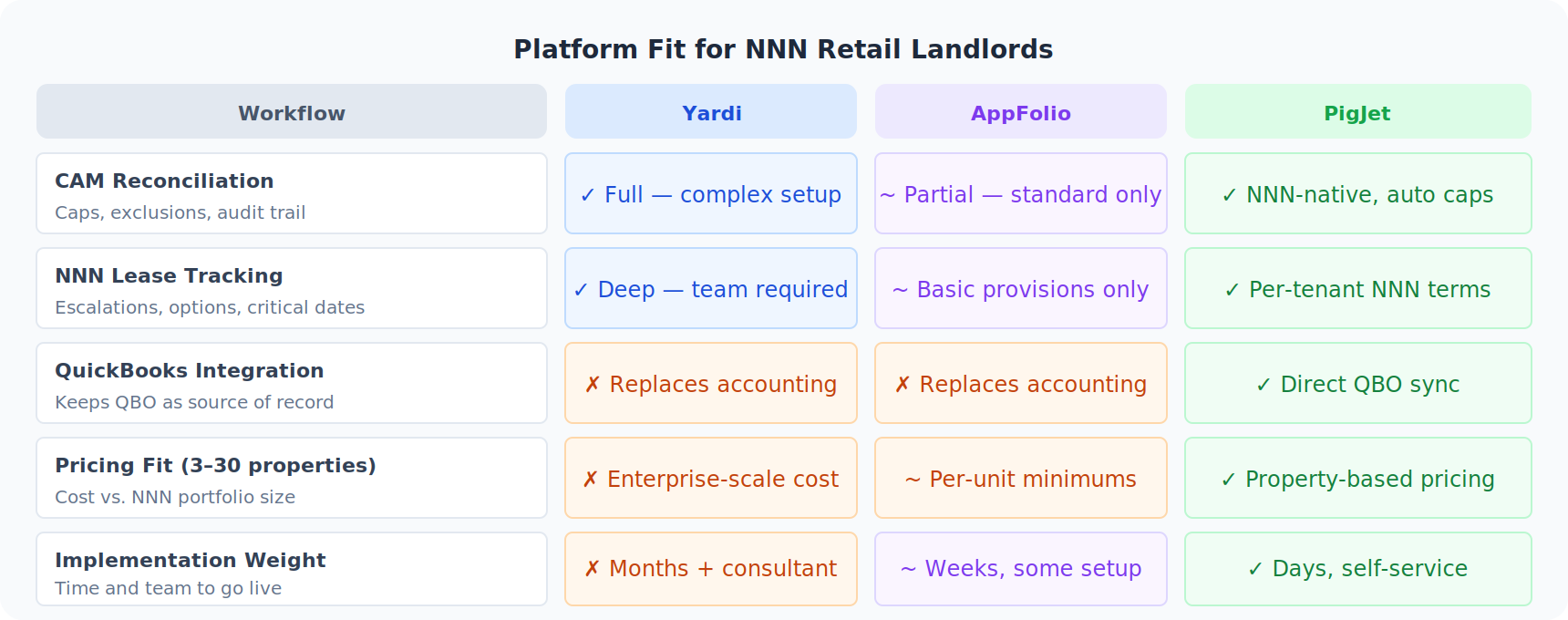
When landlords ask me which property management software to use for an NNN retail portfolio, the conversation almost always starts with AppFolio and Yardi. Both are real platforms with real customers, and neither was purpose-built for what NNN landlords actually do.
I built PigJet because I was managing NNN retail properties and kept hitting the same wall: property management software designed around residential workflows, with commercial support added as an afterthought. CAM reconciliation required spreadsheet workarounds. Lease provisions weren't stored in a way that connected to billing. QuickBooks was either replaced or ignored. This post is an honest comparison of where each platform stands for private NNN retail landlords.
The Core Difference in Three Sentences
Yardi is an enterprise platform built for institutional commercial portfolios. It does almost everything — at institutional scale, at institutional pricing, with an institutional implementation timeline. AppFolio is a polished mixed-portfolio platform that has added commercial capability without reorienting around it. PigJet is built for private NNN landlords who want lease economics handled without adopting a suite designed for someone else.
CAM Reconciliation
This is where the comparison matters most for NNN landlords. Triple-net CAM reconciliation requires tracking expense pools by property, applying individual lease rules for each tenant — participation, exclusions, caps — calculating pro-rata shares with the correct denominator, and producing a defensible year-end statement that can survive a tenant audit.
Yardi has full CAM functionality: controllable and uncontrollable expense splits, cumulative cap tracking, detailed audit outputs. The challenge is configuration depth. Most small and mid-size NNN operators don't have a dedicated implementation team, and Yardi's CAM module requires one to set up correctly.
AppFolio supports common area maintenance tracking and has expanded its commercial accounting tools. For portfolios where CAM accuracy and cap enforcement are the central risk, operators often find the tools cover standard scenarios but require supplemental tracking for complex per-lease exceptions — layered exclusion lists, cumulative caps that compound across years, gross-up provisions.
PigJet was designed around this workflow. Expense categorization is tied to individual lease terms. CAM cap tracking — including cumulative year-over-year caps — runs automatically. Reconciliation statements are generated from the same data source as estimates, which means the audit trail exists before a tenant asks for it. For more detail, see CAM reconciliation for NNN landlords.
Triple-Net Lease Tracking
An NNN lease isn't just a rent record. It contains base rent, rent escalation schedule, CAM participation rules, expense exclusions, option periods, critical dates, and security deposit terms. How a platform stores and surfaces those provisions determines whether it's actually reducing operational risk.
Yardi stores deep lease data. For a large commercial portfolio managed by a dedicated team, Yardi's lease administration module is comprehensive. For a landlord managing 5 to 20 NNN tenants without dedicated staff, accessing and maintaining that data requires significant setup effort.
AppFolio supports commercial leases with rent tracking, escalations, and critical date alerts. Lease abstraction depth varies, and complex NNN provisions — layered exclusion lists, cumulative cap tracking, gross-up calculations — often require external tracking to maintain through lease term.
PigJet stores NNN lease provisions at the individual tenant level and applies them automatically through rent rolls, CAM calculations, and critical date alerts. For a landlord whose tenants hold 10-year leases with distinct exclusion lists and option windows, that structure matters at reconciliation time, not just at signing.
QuickBooks Integration
Most private commercial landlords aren't looking to replace their accounting system. Their CPAs know QuickBooks. Their chart of accounts is set up. The question is whether property management software works with that setup — or requires you to abandon it.
Yardi has its own general ledger and accounting module. Most Yardi implementations shift accounting into Yardi or require a significant integration build to keep QuickBooks relevant. For landlords committed to QuickBooks Online, this is a real migration cost: chart of accounts cleanup, historical balance moves, new close procedures, and retraining external accounting support.
AppFolio also has built-in accounting and is typically positioned as the primary accounting system. QuickBooks integration exists via export tools, but AppFolio is not designed to be a layer on top of QuickBooks Online — it's designed to replace it.
PigJet integrates with QuickBooks directly. Rent charges, CAM estimates, and reconciliation true-ups flow into QuickBooks Online rather than around it. The goal is keeping QuickBooks as the accounting source of record while PigJet handles the lease logic that generates the entries. For landlords whose accountants and CPAs are already in QuickBooks Online, this distinction avoids a migration that creates disruption without adding value.
---
---
Pricing and Scale
Yardi pricing varies by module and implementation. Yardi Breeze Premier, the entry point for smaller commercial portfolios, runs several hundred dollars per month. Full Yardi Voyager engagements are five-figure annual commitments with multi-month implementations. For a 6-property NNN portfolio, Yardi's breadth typically outpaces what the operation actually requires.
AppFolio is priced at $3 per unit per month with minimums that don't translate cleanly to NNN portfolios. A landlord with 8 commercial tenants across 3 properties pays more per unit than a 200-unit residential operator while getting features largely designed for that residential use case.
PigJet is priced for small and mid-size commercial operators — property-based pricing without residential per-unit minimums.
The Honest Assessment
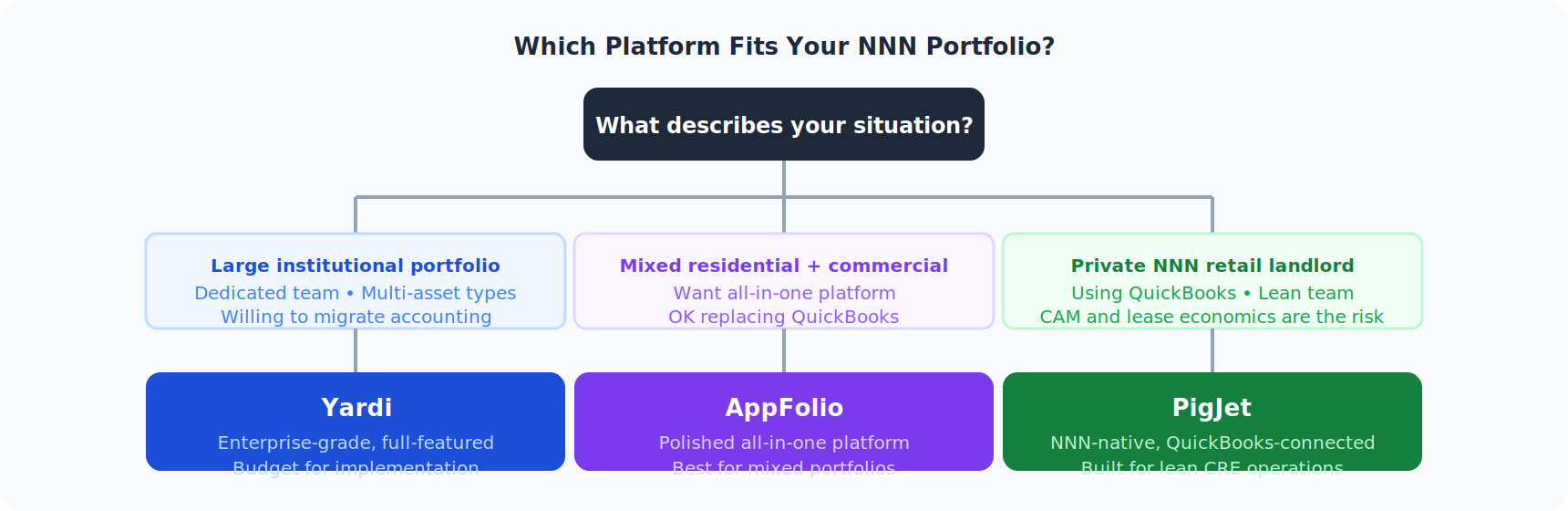
If you're an institutional operator with a large commercial portfolio and a dedicated implementation team, Yardi deserves a serious evaluation.
If you're managing a broad mix of residential and commercial properties and want one platform to handle both, AppFolio is worth evaluating on its own terms.
If you're a private NNN retail landlord using QuickBooks, managing somewhere between 3 and 30 properties, and your hardest operational problems are CAM accuracy, lease economics, and reconciliation documentation — that's the specific gap PigJet was built to fill.
See how PigJet handles NNN lease management, or use the free CAM Calculator to run through the reconciliation math for your own portfolio.